15 Digital Detox Activities for Kids Who Love Screens
Short answer: The easiest way to cut down on screen time is to give kids something more exciting to do. Outdoor adventures, building projects, science experiments, cooking, board games, and make-believe play all work well because they offer a goal, not just a rule.
Getting a child to put down a tablet is rarely easy. Screens are built to hold attention, and kids enjoy the games, videos, and chats they offer.
However, you don't need to remove technology completely. A better plan is to balance screen time with chances to move, create, explore, and talk.
So if your child says "I'm bored!" the moment the Wi-Fi goes off, don't worry. With the right ideas, screen-free time can feel like an adventure instead of a punishment.
What Is a Digital Detox for Kids?
A digital detox for kids is a planned break from recreational screens such as tablets, phones, consoles, computers, and TV. During that time, children do offline activities instead.
It doesn't mean banning technology. Kids use devices for schoolwork, staying in touch, and creating things, and those uses are fine. The point of a detox is simply to make room for the other parts of childhood too.
Quick answer: A digital detox for kids is a planned period with less recreational screen use. It works best when parents offer fun alternatives, such as outdoor play, crafts, cooking, STEM challenges, board games, and family activities.
Why Do Kids Need Screen-Free Activities?
Children grow best with a mix of experiences. Time away from screens gives them space to move, talk face to face, create, solve problems, and play on their own. Depending on the activity, they can build:
- Creativity and imagination
- Communication and social skills
- Problem-solving and critical thinking
- Coordination and physical fitness
- Patience and persistence
- Independence and decision-making
Above all, offline activities shouldn't feel like extra schoolwork. Kids need free play too.
15 Digital Detox Activities for Kids
1. Create a Backyard Treasure Hunt
Turn your yard, a park, or even the living room into an adventure zone. Hide small objects and write clues that lead from one spot to the next. Younger kids can follow picture clues, while older kids can crack riddles, codes, or simple math puzzles.
For an extra challenge, ask your child to plan the next hunt for the family.
Skills: observation, reading, problem-solving, teamwork.
2. Build Something With Cardboard
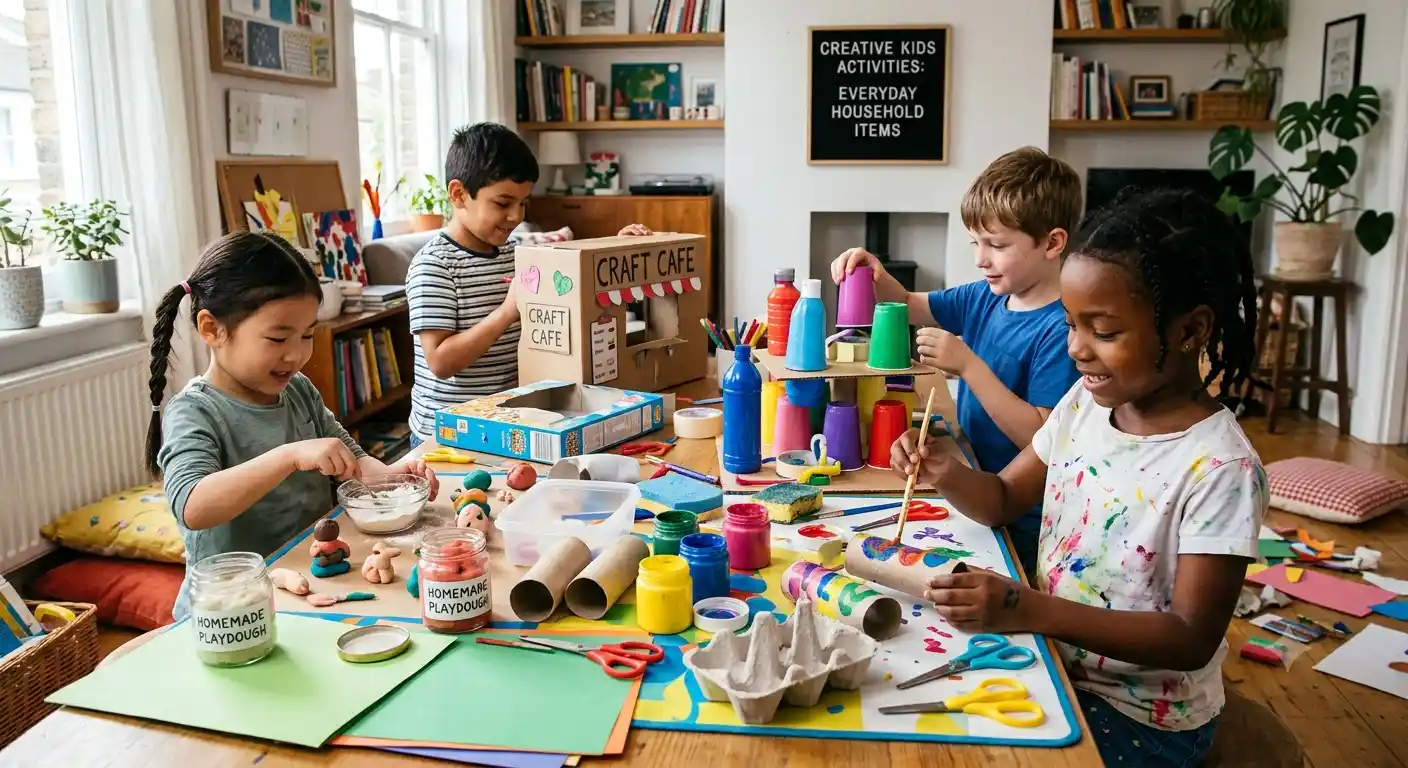
Before those delivery boxes go in the recycling bin, give them a second life. Kids can turn them into a castle, robot, spaceship, shop, or a whole tiny city. Hand over tape, markers, and child-safe scissors, and let their imagination lead.
Try a challenge: "Can you build a cardboard house big enough for three of your toys?"
Skills: design thinking, planning, creativity, spatial awareness.
3. Try a Simple STEM Experiment
Kids who love games and tech often enjoy finding out how things work. Try a baking soda and vinegar reaction, a sink-or-float test, a paper bridge challenge, or a balloon-powered car. Before you start, ask your child to predict what will happen. That one question turns play into real scientific thinking.
Skills: curiosity, observation, prediction, reasoning.
4. Have a Screen-Free Cooking Challenge
Invite your child into the kitchen with a simple mission. Fruit skewers, mini pizzas, smoothies, and decorated toast are all easy places to start. Let them measure, mix, arrange, and help clean up. As a result, they practice math and planning without ever seeing a worksheet.
Skills: measuring, following instructions, independence, creativity.
5. Make a Family Board Game Tournament
Bring out the board games and turn an ordinary evening into a tournament. Pick games that use strategy, memory, or counting, and keep a simple scoreboard. Winning matters less than the time together, since kids also practice patience and communication along the way.
Skills: strategy, communication, patience, memory.
6. Build a DIY Obstacle Course
Cushions, chairs, boxes, and ropes make a great course, indoors or out. Kids can crawl, jump, balance, and weave around obstacles. Once they finish yours, let them design a new one.
Skills: coordination, balance, physical activity, planning.
7. Start a Mini Garden
Growing something gives kids a reason to look up from the screen and watch the real world change. Herbs, beans, flowers, or an indoor plant are all easy choices. Your child can water it, measure it each week, and keep a simple growth journal.
Skills: responsibility, patience, observation, basic science.
8. Create a Family Mystery Game
Give your child a case to solve, such as a missing toy or a strange note. Hide clues around the house and let them piece the answer together. Older children can also write a mystery for their siblings or parents.
Skills: logic, memory, reading, reasoning.
9. Have a Creative Art Challenge
Set one challenge for the whole family, like drawing an imaginary animal, designing a futuristic house, or painting an underwater city. There's no need for a winner. Instead, the fun comes from seeing how differently everyone tackles the same idea.
Skills: imagination, self-expression, confidence.
10. Build a Blanket Fort
A blanket fort looks simple, yet it can become almost anything. One day it's a secret headquarters, and the next it's a spaceship, a reading nook, or a restaurant. Give your child blankets, pillows, and safe furniture, then let them decide.
Skills: imaginative play, planning, cooperation.
11. Go on a Nature Scavenger Hunt
Take your child outside with a list of things to find. Use descriptions instead of names to make them look closely:
- Something rough
- Something smooth
- A leaf with an unusual shape
- Something that makes a sound
- A small insect
- A natural object that feels soft
This encourages kids to slow down and notice what's around them.
Skills: observation, curiosity, movement, environmental awareness.
12. Make Your Own Board Game
Why not let your child be the game designer? Give them cardboard, paper, dice, and markers. They choose the theme, draw the board, write the rules, and test it with the family. If the first version doesn't work, that's fine, because fixing the rules is part of the fun.
Skills: creativity, math, writing, planning, problem-solving.
13. Try a Storytelling Challenge
Give your child three unrelated words, such as robot + jungle + pizza, and ask for a story that uses all of them. Then let another family member add the next sentence. The story usually gets sillier with every turn, and it needs almost no preparation.
Skills: vocabulary, listening, imagination, communication.
14. Have a Family Sports Day
Set up a mini sports day at home or in a local park. Races, jumping contests, balancing games, target throwing, and relays all work well. Let the kids invent an event or two. Keep the focus on taking part so that children of every ability can enjoy it.
Skills: coordination, teamwork, confidence, sportsmanship.
15. Give Them a "Create Anything" Challenge
Sometimes kids don't need a detailed plan. They just need permission to create. Give your child 30 to 60 minutes, a few basic materials, and one simple instruction:
"You have no screens. What can you create?"
Your child might build a machine, draw a comic, write a story, invent a game, or make something you never expected.
Open-ended play like this helps kids make their own decisions without waiting for an adult to tell them what to do.
How Can Parents Make a Digital Detox Easier?
Taking a device away rarely works if there's nothing interesting to replace it. For that reason, make screen-free activities easy to start.
Keep Activities Visible
Store blocks, art supplies, puzzles, books, and balls where kids can see them. When something is ready to grab, getting started takes less effort.
Offer Choices
Children join in more willingly when they have some control. Instead of "Stop playing and go outside," try "Would you like to build something or go on a treasure hunt?" Two simple options are usually enough.
Make It a Family Activity
You don't have to supervise from the sidelines. Build, cook, draw, or explore alongside your child. When adults take part, the activity feels like family time, not an order.
Create a "Boredom Box"
A boredom box is an easy way to help kids find something to do when they reach for a screen. Fill a box with cards, each showing one idea, such as:
- Build a paper airplane
- Draw an imaginary creature
- Create a treasure hunt
- Build something from cardboard
- Make up a new board game
- Write a funny story
- Try a science experiment
- Build a blanket fort
Next time your child says "I'm bored," they can simply pick a card.
Should Parents Ban Screens Completely?
For most families, the answer is no. Devices are now part of learning, communication, and creative play. A more useful question is how screens fit into your child's day.
Look at whether recreational screen use is getting in the way of sleep, exercise, schoolwork, family time, or outdoor play. If it is, a digital detox can be as simple as setting regular times when screens go away and another activity takes over.
What If My Child Says Every Screen-Free Activity Is Boring?
This is very common, especially when a child is used to fast, exciting digital entertainment. Don't expect instant excitement about every idea.
Instead, start with your child's own interests. If they love video games, ask them to design a board game. If they love building games, hand them cardboard and blocks. If they enjoy racing games, set up an obstacle course or a family race.
The goal isn't to copy digital entertainment. Rather, use what your child already loves as a bridge to offline play.
Digital Detox Activities by Skill
| Activity | Skills Children Can Practice |
|---|---|
| Treasure Hunt | Problem-solving, reading, observation |
| Cardboard Building | Creativity, planning, spatial thinking |
| STEM Experiment | Scientific thinking, curiosity, reasoning |
| Cooking | Measuring, independence, planning |
| Board Games | Strategy, communication, patience |
| Obstacle Course | Coordination, balance, movement |
| Gardening | Responsibility, observation, patience |
| Mystery Game | Logic, memory, reasoning |
| Art Challenge | Creativity, confidence, self-expression |
| Storytelling | Vocabulary, imagination, communication |
How to Start a Simple Screen-Free Routine
You don't need a whole day without technology. Begin with a small routine your family can realistically keep.
| Time | Possible Activity |
|---|---|
| After School | Snack, rest, and outdoor movement |
| Late Afternoon | Homework or hands-on learning |
| Early Evening | Creative activity, game, or family time |
| After Dinner | Reading, storytelling, puzzles, or quiet play |
Feel free to adjust this to fit your family's schedule. Even one screen-free block a day can make a real difference over time.
Final Thoughts
Kids who love screens can still get excited about offline fun. All it takes is the right challenge, a little preparation, and some choice on their part.
Start small, pick one or two activities from this list, and see what your child enjoys most. Before long, "I'm bored" may turn into "Look what I made!"
Frequently Asked Questions
What is a digital detox for kids?
It is a planned break from recreational screens, with offline activities in their place. It doesn't mean banning technology for good.
What can kids do instead of using screens?
Kids can go on treasure hunts, build with cardboard, cook, garden, play board games, do science experiments, make art, tell stories, or run an obstacle course.
How do I get my child to give up their tablet?
Offer an exciting alternative and a choice, instead of simply taking the device away. A specific challenge, like a treasure hunt or a building contest, works better than "go play."
Should I ban screens completely?
Usually not. Instead, look at how screens affect sleep, exercise, schoolwork, and family time, then set regular screen-free periods.
What if my child says everything is boring?
Start with their interests. For example, a child who loves video games may enjoy designing a board game, and a racing fan may love an obstacle course.