25 Gen Alpha Activities That Are More Fun Than Screen Time
Short answer: The best screen-free activities for Gen Alpha kids come with a challenge, a mission, or something to build. Treasure hunts, science experiments, cardboard cities, obstacle courses, and cooking challenges all work well because they give children a goal instead of just an instruction to "go play." Below are 25 ideas that kids often want to do without being pushed.
Screens are a normal part of childhood today. Kids use tablets, phones, and consoles to play, talk to friends, create, and learn. However, when devices take over most of a child's free time, many parents start looking for other options.
The good news is that you don't have to remove screens completely. Instead, offer activities exciting enough that children choose to put the device down on their own.
What Are Gen Alpha Activities?
Gen Alpha activities are built around how today's children like to play and learn. Generation Alpha generally means kids born from the early 2010s to the mid-2020s. Because these children grew up around technology, screen-free activities work best when they involve creativity, problem-solving, movement, or hands-on discovery.
That said, not every activity has to teach something. Kids also need time to imagine, make mistakes, get messy, and simply have fun.
Why Do Kids Need Screen-Free Activities?
Screen-free play lets children practice skills that screens don't always build. Depending on the activity, they can work on:
- Creativity and imagination
- Communication and teamwork
- Problem-solving and critical thinking
- Fine and gross motor skills
- Patience, confidence, and decision-making
The best activities don't feel like extra homework. Kids pick them because they're fun.
Make Screen-Free Time Feel Like an Adventure
Instead of simply saying, "Put the tablet away," give your child a mission. A challenge such as "Can you build a bridge that holds 10 toy cars?" can immediately make play more exciting.
25 Fun Gen Alpha Activities to Try
1. Create a Backyard Treasure Hunt
Turn your yard, garden, or even the living room into an adventure zone. Hide small objects and write clues that lead from one spot to the next.
For younger kids, keep the clues simple. Older kids, on the other hand, will enjoy riddles and math puzzles. Better still, let your child draw the treasure map.
Skills: Problem-solving, reading, observation, teamwork.
2. Build a Cardboard City
Before you recycle those delivery boxes, turn them into a tiny city. Kids can make houses, shops, schools, roads, bridges, and parks.
Hand over markers, tape, and scissors, then let them invent stories about the people who live there.
Skills: Creativity, planning, spatial awareness, imaginative play.
3. Try a Mini Science Experiment
Children love finding out what happens when they mix, build, and test things.
Some easy options include a baking soda and vinegar volcano, a float-or-sink test, growing crystals, or a balloon-powered car.
Just pick age-appropriate experiments and stay close when adult help is needed.
Skills: Scientific thinking, observation, curiosity.
4. Set a No-Screen Cooking Challenge
Give your child a simple recipe and let them be the chef. Fruit skewers, mini pizzas, smoothies, and decorated toast are all good starting points.
As a result, they practice measuring, planning, and creativity without realizing it.
Skills: Measurement, independence, planning.
5. Build the Tallest Tower
Hand out paper cups, straws, craft sticks, or blocks, and set one mission: build the tallest tower that stays up.
You can make it a family contest or allow several tries. Afterward, ask what made one tower stronger than another.
Skills: Engineering thinking, balance, persistence.
6. Start a Family Board Game Tournament
Board games beat passive screen time, especially those with strategy, counting, or memory.
To make it more exciting, run a small tournament with points for each round. Kids can even design the scoreboard.
Skills: Strategy, patience, communication.
7. Make a DIY Obstacle Course
Use cushions, chairs, ropes, and boxes to build a course at home. Kids can crawl under a chair, jump between marked spots, or balance along a line.
Once they've tried yours, let them design one for the family.
Skills: Coordination, balance, creativity.
8. Try a Building Block Challenge
Instead of saying "build whatever you like," give a specific goal.
For example, ask for a bridge that can hold ten toy cars, or a house for an imaginary family of five.
A clear challenge turns ordinary blocks into an engineering project.
Skills: Design, spatial reasoning, problem-solving.
9. Make a Stop-Motion Movie
Yes, this one uses a device. Even so, it's very different from watching videos.
Kids create characters from toys or paper, build a set, take photos, and edit a short story. In this case, the screen is a creative tool, not just entertainment.
Skills: Storytelling, planning, digital creativity.
10. Go on a Nature Scavenger Hunt
Take kids outside with a list of things to find, such as something rough, something smooth, a yellow flower, or three different leaves.
They can tick off each find as they go.
Skills: Observation, movement, curiosity.
11. Create a Family Mystery Game
Give kids a mystery to solve, like "Who took the last cookie?" Then hide clues around the house for them to follow.
Older children can also design mysteries for younger siblings.
Skills: Logical reasoning, reading, memory.
12. Make Your Own Board Game
Why only play games when you can invent one?
Give kids paper, cardboard, dice, and small objects for game pieces. They choose the theme, rules, and scoring, and then the whole family plays the finished game.
Skills: Creativity, math, rule-making.
13. Have a Family Art Challenge
Set the same task for everyone, such as drawing an imaginary animal or designing a house on Mars.
There's no need for a winner. Instead, the fun is in seeing how differently each person tackles the same idea.
Skills: Imagination, self-expression, confidence.
14. Build a Blanket Fort
Few things beat a classic blanket fort. Once it's ready, it can become a reading corner, a spaceship, a restaurant, or a secret headquarters.
Let your child's imagination decide.
Skills: Imaginative play, cooperation, planning.
15. Try a "Can You Invent It?" Challenge
Present an everyday problem, such as how to carry five books without a bag or how to keep an ice cube from melting.
Kids sketch an idea first and then build a rough prototype. It doesn't have to work perfectly, because the thinking is what counts.
Skills: Innovation, critical thinking, engineering.
16. Start a Mini Garden
Give your child something to grow, like herbs, beans, flowers, or a small indoor plant.
They can water it, watch it change, and keep a simple growth journal. Measuring the plant each week makes it even more fun.
Skills: Responsibility, patience, basic science.
17. Host a Family Sports Day
Set up a few easy events, such as races, jumping contests, relays, or target throwing.
Let the kids invent some events too. Above all, focus on taking part instead of winning.
Skills: Coordination, teamwork, sportsmanship.
18. Play a Storytelling Game
Give your child three random words, like "robot," "jungle," and "pizza," and ask for a story that uses all three.
To add a twist, set a timer or let each family member add one sentence.
Skills: Vocabulary, imagination, communication.
19. Create a DIY Puzzle Room
You don't need a real escape room. Instead, string together riddles, number puzzles, hidden messages, and simple codes that lead to a final prize.
Match the difficulty to your child's age.
Skills: Logical thinking, concentration, persistence.
20. Hold a Music and Dance Challenge
Put the phones away and put on a family show.
Kids can make up a dance, build simple instruments, or write a song. Shy children can still join in by making tickets, designing the stage, or helping with costumes.
Skills: Rhythm, confidence, self-expression.
21. Take a Photography Walk
Ask your child to find five interesting things to photograph, like shapes, patterns, shadows, or textures.
Afterward, have them explain why they chose each one. This way, taking pictures becomes a lesson in noticing details.
Skills: Observation, visual thinking, communication.
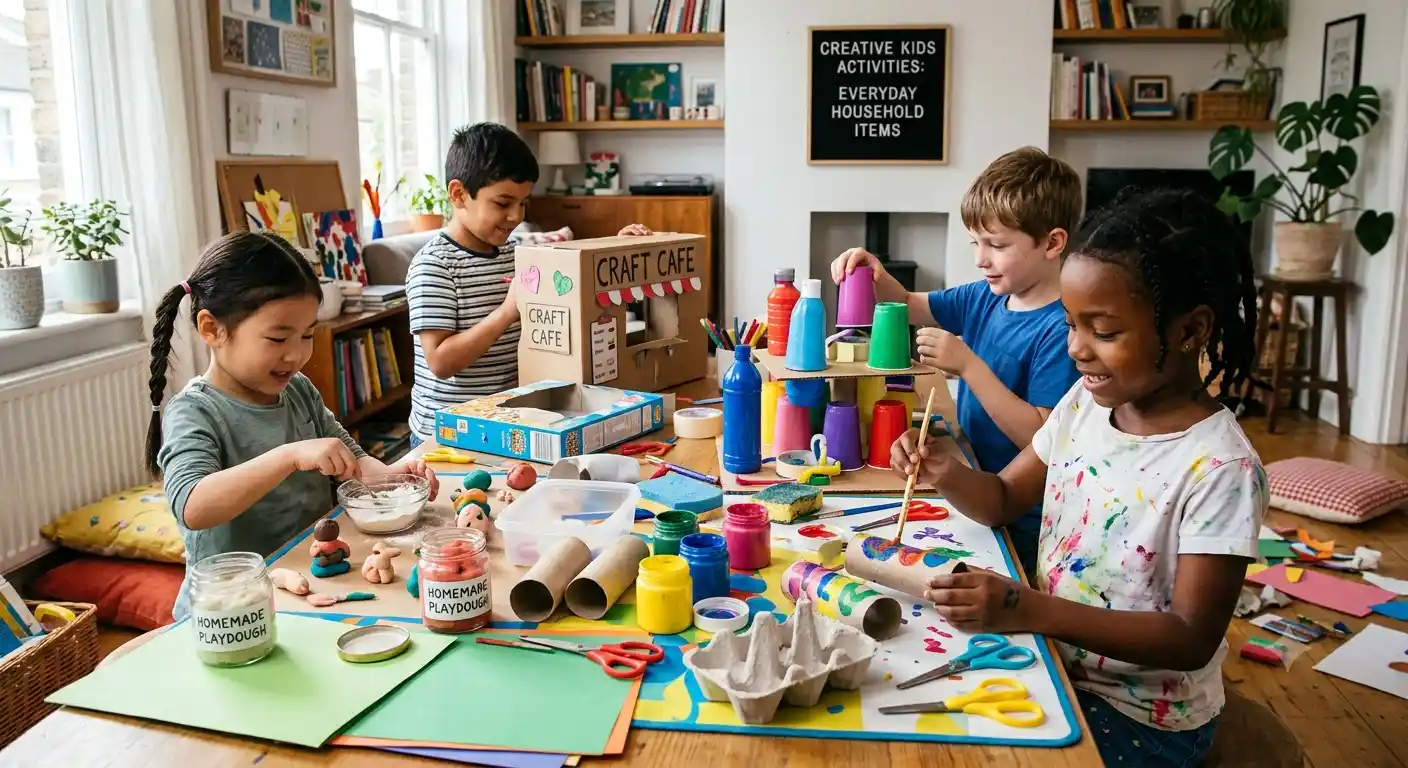
22. Make a Recycled Invention
Collect clean cardboard, paper rolls, bottle caps, and containers.
Then set one challenge: make something useful. It might turn into a pencil holder, a robot, or an imaginary machine.
Skills: Design thinking, creativity, sustainability awareness.
23. Have a "Teach Me Something" Day
Let your child be the teacher for a day.
They might show the family how to draw something, play a game, or do a favorite craft. Explaining the steps clearly is a great confidence booster.
Skills: Communication, leadership, organization.
24. Plan a Mini Adventure
You don't have to travel far. A local park, a new walking route, or a family picnic will do.
Give your child a small mission, like finding three things they've never noticed before.
Skills: Curiosity, independence, physical activity.
25. Let Kids Design Their Own Activity
Sometimes the best idea comes from the child.
Try saying, "You have 30 minutes and no screens. What can you create?"
They may build, draw, write, or invent something you never expected.
Skills: Decision-making, independence, self-directed learning.
How Can You Make Screen-Free Activities More Appealing?
Simply taking a device away rarely makes a child excited about something else. For this reason, the alternative needs to feel interesting.
Add a Challenge
Instead of "Go play outside," try "Can you find five different leaves in 20 minutes?" A mission sparks curiosity.
Let Kids Make the Rules
When children change a game or invent a challenge, they feel a sense of ownership.
Make It Social
Invite siblings, cousins, friends, or parents. Many activities feel more exciting when someone shares them.
Skip the Lesson
Not everything needs a learning goal. A cardboard fort doesn't have to teach math to be worth building.
What Is a Healthy Balance Between Screen Time and Screen-Free Time?
The goal doesn't have to be zero screens. Technology is part of modern childhood, and kids can use it to learn, create, and stay in touch with others.
What matters is balance.
Over the course of a day, children benefit from a mix of active play, creative time, reading, social time, outdoor exploration, family time, and rest.
Rather than only counting minutes, ask what your child is doing on the screen and what they might be missing.
In particular, watch for signs that screens are cutting into sleep, physical activity, schoolwork, or family routines.
Parent tip: Instead of making screen-free time feel like a punishment, make it something your child looks forward to. A weekly family challenge, outdoor adventure, or creative project can become a fun routine.
How Can You Help Kids Put the Screen Down?
Make screen-free activities easy to start. Keep art supplies within reach, store building blocks where kids can see them, and leave balls and outdoor toys ready to grab.
You can also make a "boredom box" filled with activity cards.
- Build something
- Draw an imaginary animal
- Create a treasure hunt
- Make a paper airplane
- Write a funny story
- Do a science experiment
- Make a fort
- Design a board game
- Invent a new game
Is Boredom Actually Good for Kids?
In many ways, yes. Parents often feel pressure to keep children entertained every minute, but kids don't need a planned activity all day.
A little boredom gives them room to try ideas and invent their own games.
So the next time your child complains, wait a little before handing over a device. Some of the best play begins with the words "I don't know what to do."
Final Thoughts
Gen Alpha kids are growing up around technology, but that doesn't mean every fun moment has to happen on a screen. They can still get excited about forts, inventions, outdoor adventures, art, cooking, and made-up worlds.
Notably, the best activities aren't always the most complicated ones. They're the ones that make kids curious, active, and creative.
You don't need to remove technology from your child's life. Just give them plenty of chances to discover what's waiting beyond the screen.
Sometimes one good challenge is all it takes to turn "I'm bored" into "Look what I made!"
Frequently Asked Questions
What are fun screen-free activities for Gen Alpha kids?
Popular ideas include treasure hunts, science experiments, building challenges, board games, outdoor adventures, art projects, cooking, storytelling, obstacle courses, gardening, and DIY inventions.
How can I get my child interested in screen-free activities?
Make the activity interactive and offer a challenge or a choice. Instead of just telling your child to stop using a screen, suggest something exciting, such as a treasure hunt, a building contest, or a creative project.
Are screen-free activities educational?
Many of them build creativity, communication, problem-solving, coordination, and teamwork. However, an activity doesn't need to be educational to be valuable. Play for the sake of fun matters too.
Is all screen time bad for children?
No. Screens can support learning, creativity, and communication. A healthy approach looks at the child's whole routine, including sleep, physical activity, schoolwork, and family time.
What can my child do when they say they're bored?
Offer choices like building something, drawing, making up a game, reading, going on a scavenger hunt, or inventing a gadget. A boredom box full of activity cards can help too.