



15 Math Kids Activities That Make Learning Fun
Mathematics is an important part of everyday life, but children don't always find traditional math lessons exciting. Numbers, formulas, and worksheets can sometimes feel repetitive when children don't have an opportunity to connect mathematical concepts with real-world experiences.
That's where math kids activities can make a difference. Turning math into games, challenges, crafts, puzzles, and hands-on experiments can help children practice important concepts while having fun.
From counting games and shape hunts to measurement challenges and math scavenger hunts, there are many simple ways parents and teachers can make mathematics more interactive.
Why Are Math Activities Important for Kids?
Math activities give children opportunities to use numbers and mathematical thinking in practical situations. Instead of simply memorizing answers, children can explore how mathematics works.
Interactive activities can encourage children to develop logical thinking, concentration, pattern recognition, reasoning, and problem-solving skills.
Math doesn't always need to look like a math lesson. Counting toys, measuring ingredients, sorting objects, playing board games, and building with blocks can all provide opportunities to practice mathematical thinking.
15 Fun Math Activities for Kids
Number Scavenger Hunt
Turn your home, classroom, or outdoor space into a number hunt. Ask children to find numbers around them on clocks, books, signs, packaging, calendars, or other safe objects.
Younger children can identify numbers, while older children can create simple calculations using the numbers they discover.
Counting Challenge
Give children a collection of everyday objects such as blocks, buttons, toy cars, or pencils and ask them to count them.
Make the challenge more interesting by asking children to group objects into sets of 2, 5, or 10.
Shape Hunt
Ask children to find circles, squares, rectangles, triangles, and other shapes around the house or classroom.
They can create a list of the objects they find and discuss how different shapes are used in everyday life.
Math Bingo
Create simple bingo cards containing numbers or mathematical problems. Call out an equation and let children find the answer on their cards.
Math bingo can be adapted for counting, addition, subtraction, multiplication, shapes, or number recognition.
Build With Blocks
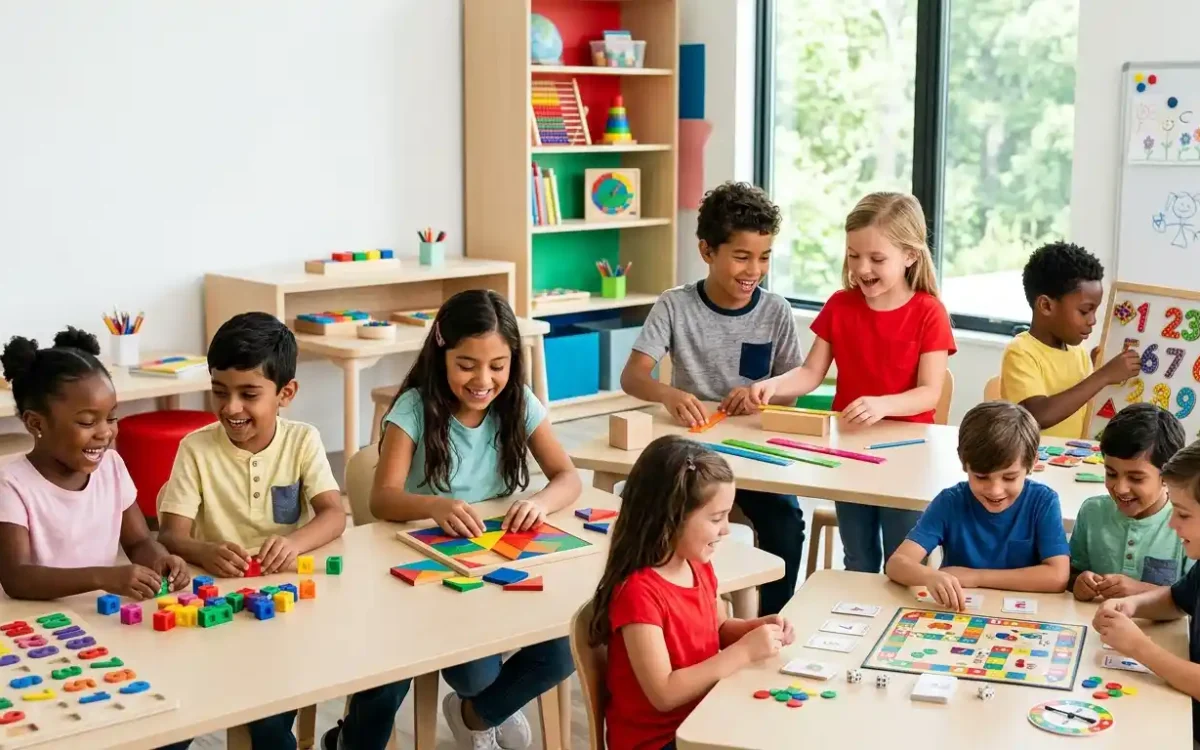
Building blocks are excellent tools for introducing mathematical concepts.
Children can count blocks, compare heights, create symmetrical structures, identify shapes, and explore patterns while building.
Measurement Challenge
Give children a ruler or measuring tape and ask them to measure suitable objects around them.
They can compare the length of books, toys, pencils, tables, or other safe objects.
Create Number Patterns
Introduce children to patterns using numbers, colors, shapes, or objects.
For example: 2, 4, 6, 8. Ask children what number comes next and encourage them to create their own patterns.
Math Card Games
Use playing cards to create simple math challenges. Children can compare numbers, add cards together, or find the difference between two numbers.
Card games can easily be adjusted according to age and ability.
Shape Building Challenge
Give children craft sticks, straws, or other safe building materials and challenge them to create different shapes.
Ask them how many sides and corners each shape has.
Math Treasure Hunt
Hide clues around a room or outdoor area. Each clue can contain a simple math problem that children must solve to discover the next location.
This combines physical activity, problem-solving, reading, and mathematics.
Sorting Challenge
Give children different objects and ask them to sort them according to size, shape, color, weight, or another characteristic.
Sorting is an excellent way to introduce classification and logical thinking.
DIY Math Board Game
Ask children to design their own board game using numbers, dice, spaces, and simple rules.
Designing a game allows children to practice counting, addition, sequencing, planning, and creative thinking.
Cooking With Math
Cooking provides plenty of opportunities to use mathematics. Children can count ingredients, measure quantities, compare amounts, and explore fractions with adult supervision.
For example, ask what happens when a recipe needs to be doubled or divided.
Math With Money
Create a pretend shop using toy products and play money. Children can practice identifying coins and notes, adding prices, and calculating simple change.
This connects mathematical skills with everyday decision-making.
Math Puzzle Challenge
Give children age-appropriate puzzles involving numbers, sequences, shapes, logic, or simple calculations.
Encourage them to explain how they reached an answer rather than focusing only on whether the answer is correct.
Skills Children Can Develop Through Math Activities
Fun math activities can support several important learning skills beyond basic arithmetic.
- Number Sense
- Logical Thinking
- Problem-Solving
- Pattern Recognition
- Reasoning
- Concentration
- Measurement
- Spatial Awareness
- Decision-Making
Math Activities for Different Age Groups
The best math activity depends on a child's age, current abilities, and interests. Activities can easily be simplified or made more challenging.
Ages 3–5
Focus on counting, colors, shapes, sorting, simple patterns, number recognition, and basic comparisons.
Ages 6–8
Introduce addition, subtraction, measurement, simple multiplication, money games, puzzles, and number challenges.
Ages 9–12
Try more complex puzzles, multiplication challenges, fractions, geometry, logic games, budgeting activities, and multi-step problems.
How to Make Math Fun at Home
Parents don't need to create a classroom at home to help children practice mathematics. Everyday situations can become opportunities for mathematical thinking.
- Ask children to count household objects.
- Let them help measure ingredients while cooking.
- Compare prices during pretend shopping games.
- Ask them to identify shapes around the house.
- Use toys to practice addition and subtraction.
- Create simple puzzles together.
- Ask children to estimate before measuring.
Math Activities for the Classroom
Teachers can also use hands-on activities to make mathematics more engaging in the classroom.
Small groups can participate in different stations, such as a measurement station, puzzle station, counting station, shape station, and problem-solving station.
This gives children opportunities to learn through movement, collaboration, experimentation, and discussion.
Connect Math With Real Life
One of the best ways to make mathematics meaningful is to show children where they use it in everyday life.
Shopping involves prices and addition. Cooking involves measurement and fractions. Travel involves distance and time. Building involves shapes and measurement. Games involve counting, probability, strategy, and scoring.
When children recognize these connections, mathematics can start to feel less like an abstract school subject and more like a useful tool they can use every day.
Math and STEM Learning
Mathematics is an important part of STEM education. Many STEM projects require children to measure, compare, calculate, organize information, recognize patterns, and solve problems.
Parents and teachers can combine math activities with science, engineering, coding, and design challenges to create richer learning experiences.
Give children a simple building challenge and ask them to create the tallest stable structure they can using a limited number of blocks. They can measure the final structure and compare results.
Final Thoughts
Mathematics doesn't have to be limited to worksheets and textbooks. Children can learn important mathematical concepts while playing, building, cooking, exploring, drawing, measuring, and solving challenges.
These 15 math kids activities provide simple ways to make learning more interactive and enjoyable. They can be used at home, in classrooms, learning clubs, or during educational activity sessions.
The goal isn't simply to help children get the right answer. It's to help them become comfortable with numbers, curious about how things work, and confident enough to approach problems from different angles.
When children discover that math can be a game, a puzzle, a challenge, or a real-world tool, learning becomes much more exciting.
Frequently Asked Questions
1. What are fun math activities for kids?
Fun math activities include counting games, number scavenger hunts, puzzles, shape challenges, measurement activities, math bingo, pattern games, card games, and hands-on problem-solving activities.
2. How can I make math more enjoyable for children?
Use games, everyday objects, movement, crafts, puzzles, and real-life situations to teach mathematical concepts. Interactive activities can make math feel more practical and engaging.
3. What math activities can young children do at home?
Young children can practice counting toys, sorting objects, identifying shapes, creating patterns, playing number games, measuring household objects, and solving simple addition or subtraction challenges.
4. How do math activities help children's development?
Math activities can strengthen logical thinking, problem-solving, concentration, pattern recognition, reasoning, number sense, spatial awareness, and decision-making skills.
5. Can math activities be used for STEM learning?
Yes. Mathematics is an important part of STEM education. Hands-on math activities can be combined with science, technology, engineering, and design challenges to make learning more practical and engaging.
Search
Recent Posts
16 September, 2026
Top Kids Activities for Preschoolers: Fun & Educational Ideas
16 September, 2026
Fun Science Activities for Kids Using Household Items