

10 Reading Kids Activities That Build Vocabulary
Reading is one of the most effective ways for children to discover new words, understand language, and develop communication skills. But reading doesn't have to mean simply sitting quietly with a book.
With the right reading kids activities, parents and teachers can turn stories, books, pictures, and everyday words into interactive learning experiences.
Vocabulary-building activities can help children understand the meaning of unfamiliar words, use new vocabulary in conversations, and become more confident readers and communicators.
Why Is Vocabulary Important for Kids?
Vocabulary is the collection of words a child understands and uses. A growing vocabulary can support reading comprehension, writing, speaking, listening, and communication.
When children understand more words, they can often understand stories, instructions, conversations, and learning materials more easily.
Children don't need to memorize long lists of words to build vocabulary. Reading stories, discussing characters, asking questions, and using new words in everyday conversations can make vocabulary learning more natural.
10 Reading Activities That Build Vocabulary
Word Detective
Choose a story or children's book and ask kids to become "word detectives." Have them look for unfamiliar or interesting words while reading.
After finding a word, talk about its meaning and ask the child to create their own sentence using it.
Picture-to-Word Game
Show children pictures of animals, objects, places, or actions and ask them to identify and describe what they see.
Encourage them to use adjectives and descriptive words rather than giving only one-word answers.
Story Word Hunt
Pick a short story and create a list of target words. Ask children to listen or read carefully and find those words in the story.
Once they find each word, discuss what it means and how it relates to the story.
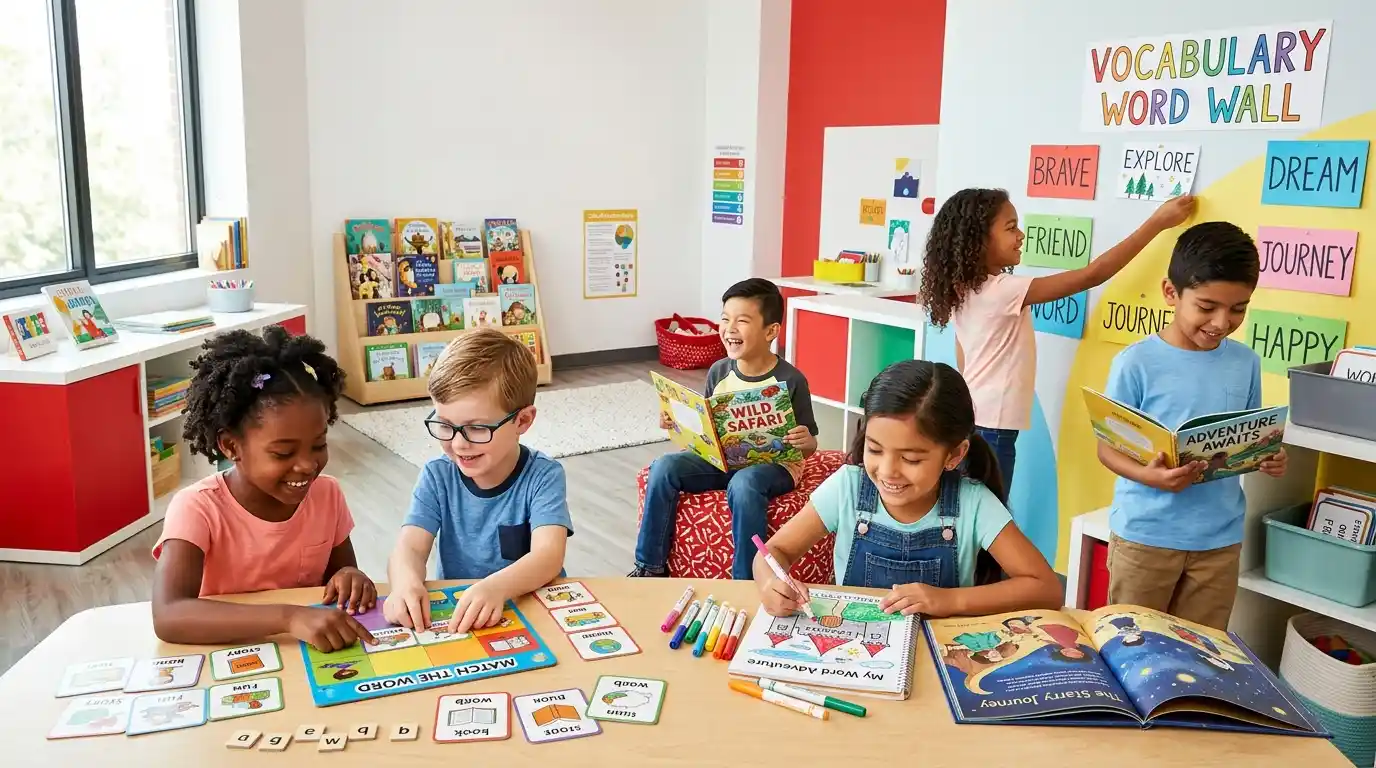
Create a Word Wall
Create a colorful word wall at home or in the classroom. Add new vocabulary words as children encounter them during reading.
Include the word, a simple meaning, and where appropriate, a drawing or example sentence.
Story Retelling
After reading a story, ask children to retell it using their own words.
Encourage them to describe the characters, setting, events, and ending while using some of the new words they learned.
Synonym and Antonym Challenge
Choose simple vocabulary words and ask children to think of words with similar or opposite meanings.
For example, children can explore words such as "big" and "large," or "hot" and "cold."
Finish the Story
Read part of a story and stop before the ending. Ask children to create their own ending using words from the story.
This activity combines vocabulary development with creativity, imagination, and storytelling.
Vocabulary Bingo
Create bingo cards containing vocabulary words or pictures. Give children definitions or clues and let them identify the correct word.
This turns vocabulary practice into an interactive game.
Make a Mini Dictionary
Give children a notebook and encourage them to create their own mini dictionary.
Each page can include a new word, its meaning, a drawing, and an example sentence.
Character Description Challenge
Ask children to choose a character from a story and describe them using as many suitable words as possible.
Encourage children to describe appearance, personality, actions, feelings, and behavior.
Skills These Activities Can Develop
Vocabulary activities can support several language and learning skills at the same time.
- Vocabulary
- Reading Comprehension
- Communication
- Listening
- Speaking
- Writing
- Creativity
- Storytelling
- Critical Thinking
Reading Activities for Different Age Groups
Reading activities should match a child's age, reading ability, and interests. A simple activity can also be made more challenging as children develop.
Ages 3–5
Focus on picture books, naming objects, identifying characters, rhyming words, simple storytelling, and describing pictures.
Ages 6–8
Introduce word hunts, simple definitions, story retelling, vocabulary bingo, synonyms, antonyms, and short writing tasks.
Ages 9–12
Encourage dictionary activities, character analysis, advanced vocabulary, creative storytelling, context clues, and more detailed word exploration.
How Parents Can Build Vocabulary at Home
Parents can support vocabulary development without turning every reading session into a formal lesson.
- Read together regularly.
- Ask children questions about stories.
- Discuss unfamiliar words naturally.
- Encourage children to describe objects and experiences.
- Let children choose books based on their interests.
- Ask children to use new words in sentences.
- Connect new words to real-life experiences.
Reading Activities for the Classroom
Teachers can use vocabulary activities as part of reading lessons, literacy stations, group work, or independent learning.
For example, one group can create a word wall while another group works on story retelling. A third group can complete a vocabulary bingo game or character-description challenge.
Group activities also give children opportunities to hear new words used by their classmates and practice using vocabulary themselves.
Teach Children to Understand Words From Context
Children won't always know the meaning of every word they encounter. Instead of immediately giving them the definition, encourage them to look at the surrounding sentence or story.
Ask questions such as:
- What do you think this word means?
- What is happening in the story?
- What clues are around the word?
- Can you replace the word with another word?
- Can you create your own sentence using it?
This helps children become more independent readers and thinkers.
Combine Reading With Creativity
Reading becomes even more engaging when children can respond creatively to what they read.
After reading a story, children can draw a scene, create a new character, write a different ending, act out a scene, or design a comic strip. Encourage them to use vocabulary from the story in their creative work.
Final Thoughts
Building vocabulary doesn't have to involve memorizing long lists of definitions. Children can discover new words naturally through stories, conversations, games, pictures, writing, and creative activities.
These 10 reading kids activities provide simple ways for parents and teachers to make vocabulary development more interactive. From becoming a word detective to creating a mini dictionary, every activity gives children an opportunity to explore language.
The goal is to help children become confident readers who are curious about words and comfortable using them.
When reading becomes an opportunity to discover, discuss, create, and imagine, children can develop vocabulary while enjoying the learning process.
Frequently Asked Questions
1. What reading activities help build children's vocabulary?
Word hunts, story retelling, vocabulary bingo, word walls, picture-to-word games, mini dictionaries, character descriptions, and synonym and antonym challenges can help children develop vocabulary.
2. How can I improve my child's vocabulary through reading?
Read together regularly, discuss unfamiliar words, ask questions about stories, encourage children to use new words in sentences, and connect new vocabulary to everyday experiences.
3. What is a fun vocabulary activity for kids?
Vocabulary bingo, word detective games, story word hunts, character-description challenges, and creating a personal mini dictionary are fun ways for children to practice new words.
4. At what age should children start vocabulary activities?
Vocabulary development begins from an early age. Young children can learn through picture books, conversations, naming games, rhymes, and simple storytelling, while older children can explore definitions, synonyms, context clues, and more advanced vocabulary.
5. Why is vocabulary important for reading?
A strong vocabulary can help children understand stories, instructions, conversations, and written information more easily. Vocabulary development also supports communication, reading comprehension, writing, and confident use of language.