

A Simple Mini Business Example for Young Entrepreneurs
Starting a business doesn't have to be complicated. Explore this simple mini business example to learn how young entrepreneurs can understand costs, pricing, sales, revenue, and profit.
Starting a business can sound like a big idea.
You might imagine a shop, employees, lots of products, and complicated numbers.
But entrepreneurship doesn't have to start that way.
For a young entrepreneur, a business can begin with something much smaller. It could be making handmade bookmarks, selling decorated notebooks, creating simple crafts, or offering a small service to people they know.
The important part is learning how an idea can turn into a product, how that product can be priced, and how to understand the money coming in and going out.
Let's look at a simple mini business example for young entrepreneurs.
What Is a Mini Business?
A mini business is a small business idea that can be started with limited products, resources, or money.
For children, the purpose isn't necessarily to build a large company immediately. Instead, a mini business can be a practical way to learn about:
- Money
- Costs
- Pricing
- Customers
- Sales
- Revenue
- Profit
- Decision-making
For example, imagine a child who enjoys drawing and creating colorful designs.
They decide to make handmade bookmarks and sell them to friends, family members, or at a school-approved activity.
That's already the beginning of a simple business idea.
Mini Business Example: Handmade Bookmarks
Let's build the business step by step.
Imagine that a young entrepreneur wants to make 20 handmade bookmarks.
They need materials such as:
After estimating the materials, they calculate that making one bookmark costs approximately Rs. 30.
They decide to sell each bookmark for Rs. 50.
Now we have the basic numbers for the business.
Calculate the Total Cost
The first thing a young entrepreneur should understand is that products usually cost money to make or obtain.
If one bookmark costs Rs. 30 and the child makes 20 bookmarks:
So the estimated total product cost is:
This is an important business lesson.
Before thinking about how much money you can make, you need to understand how much money you are spending.
Choose a Selling Price
Now the young entrepreneur needs to decide how much to charge.
But pricing isn't simply about choosing the biggest number possible.
A young entrepreneur can ask:
- Is the price affordable for customers?
- How much does the product cost to make?
- Is the product useful or attractive?
- What are similar products selling for?
- Would someone actually pay this price?
These questions help children understand that pricing is a business decision.
Calculate Revenue
Revenue is the total money a business receives from sales before subtracting costs.
If the child sells 20 bookmarks for Rs. 50 each:
So the potential revenue is:
That sounds exciting.
But we're not finished yet.
A business cannot simply call all Rs. 1,000 profit.
Why?
Because making the bookmarks cost money.
Calculate Potential Profit
Now we compare revenue with total costs.
This is one of the most important concepts for a young entrepreneur to understand.
The business made Rs. 1,000 in sales, but after the estimated product costs of Rs. 600, the remaining amount is Rs. 400.
For more practice, children can experiment with different numbers using the Kids Profit Calculator .
The Mini Business Numbers at a Glance
| Business Item | Amount |
|---|---|
| Cost per bookmark | Rs. 30 |
| Selling price | Rs. 50 |
| Products sold | 20 |
| Total cost | Rs. 600 |
| Revenue | Rs. 1,000 |
| Potential profit | Rs. 400 |
What If the Young Entrepreneur Changes the Price?
This is where things become interesting.
Suppose the child changes the selling price from Rs. 50 to Rs. 60.
If they still sell 20 bookmarks:
The estimated cost remains Rs. 600.
The child could then compare the two scenarios.
| Selling Price | Revenue | Cost | Potential Profit |
|---|---|---|---|
| Rs. 50 | Rs. 1,000 | Rs. 600 | Rs. 400 |
| Rs. 60 | Rs. 1,200 | Rs. 600 | Rs. 600 |
That's where real entrepreneurship becomes more than just mathematics.
Pricing Is About More Than Profit
A higher price doesn't automatically mean a better business.
Imagine that customers think Rs. 60 is too expensive and only 10 people buy the bookmarks.
The revenue would become:
If the total cost of producing those 10 bookmarks is Rs. 300:
Now the potential profit is only Rs. 300.
Entrepreneurs have to think about both price and customers. A good business decision considers what a product costs, what customers might pay, and how many products could realistically be sold.
What Can Young Entrepreneurs Do With Their Profit?
Let's return to our original example.
The business has a potential profit of Rs. 400.
The young entrepreneur now has another decision to make.
Save
Save some money for a future goal.
Reinvest
Buy more materials or improve the product.
Create
Use the money to explore another business idea.
Share
Set aside some money for a cause or someone else.
For example, they might decide:
This turns a simple business activity into a lesson about money management and financial decision-making.
A Mini Business Can Teach Big Lessons
A small business doesn't need to generate thousands of rupees to provide a valuable learning experience.
Even a simple project can teach children how to:
Understand Costs
Every product or service may have costs associated with creating and delivering it.
Set Prices
Entrepreneurs need to think carefully about what they charge customers.
Calculate Revenue
Sales revenue can be estimated by multiplying the selling price by the number of products sold.
Understand Profit
Profit is generally calculated by subtracting relevant business costs from revenue.
Make Decisions
Entrepreneurs make decisions about products, prices, customers, and spending.
Set Goals
Children can set a sales or savings goal and work toward it.
Try a Mini Business Challenge
Want to turn this example into an activity?
Ask your child to create their own imaginary business.
Ask Five Simple Questions
Children can then change the numbers and see how different decisions affect their business.
Use a Profit Calculator to Test the Idea
Once your child has created a mini business idea, the next step is to test the numbers.
The Kids Profit Calculator can help children explore the relationship between cost, selling price, sales, revenue, and potential profit.
Try the Kids Profit CalculatorYou can also explore the complete collection of Kidspreneur Tools for more interactive activities covering budgeting, saving, pricing, business ideas, and other money concepts.
Parents Can Turn This Into a Weekend Activity
You don't need a complicated business plan to introduce entrepreneurship at home.
Choose one simple product.
Sit with your child and work through the numbers together.
Then ask:
Or:
Or:
Let the child calculate the answers.
The goal isn't to get every answer perfect.
The goal is to encourage curiosity, problem-solving, and financial thinking.
Teachers Can Use This as a Classroom Activity
This mini business example can also become a simple classroom entrepreneurship project.
Students can work individually or in small groups.
Give each group a hypothetical product and ask them to create a mini business plan.
At the end, each student or group can explain why they selected their price.
What Makes a Good Mini Business Idea for Kids?
A good mini business idea doesn't necessarily need to be complicated.
Simple
The child should be able to understand what they are selling.
Creative
The product or service can allow them to use their interests and imagination.
Affordable
The activity should not require a large amount of money to understand the basic business concept.
Useful
A product that provides value can make the business idea easier to understand.
Easy to Explain
Children should be able to answer what they are selling and why someone might want it.
The Bigger Lesson Behind a Small Business
The real value of a mini business isn't always the amount of money a child makes.
It's the experience of making decisions.
A child who creates and prices a small product begins to understand that businesses involve choices.
And perhaps most importantly:
That's the mindset young entrepreneurs can start developing through simple, practical activities.
Final Thoughts
A mini business can be a great way for children to explore entrepreneurship without making the experience complicated.
Our handmade bookmark example started with a simple idea and a few numbers.
From there, the young entrepreneur learned about:
- Costs
- Selling prices
- Revenue
- Profit
- Customers
- Savings
- Reinvestment
- Business decisions
That's what makes a small business activity so useful.
It turns an abstract idea like "entrepreneurship" into something a child can actually see, calculate, discuss, and understand.
So the next time a child says, "I want to start a business," don't immediately worry about making it perfect.
That simple conversation could be the beginning of an entrepreneurial journey.
Mini Business FAQs for Young Entrepreneurs
What is a mini business for kids? +
A mini business for kids is a small business project that helps children learn about products, customers, costs, pricing, sales, revenue, and profit through practical activities.
What is a good mini business idea for a young entrepreneur? +
Simple ideas such as handmade bookmarks, greeting cards, crafts, artwork, gift boxes, or other age-appropriate products can help children explore entrepreneurship. The best idea depends on the child's interests, skills, resources, and available opportunities.
How do kids calculate profit? +
A simple way to calculate potential profit is to subtract total business costs from revenue. Revenue can be estimated by multiplying the selling price by the number of products sold.
What is the difference between revenue and profit? +
Revenue is the money generated from sales before subtracting costs. Profit is the amount remaining after relevant business costs are subtracted from revenue.
How can parents teach entrepreneurship to children? +
Parents can start with simple activities such as creating a pretend business, choosing a product, estimating its cost, setting a selling price, and calculating potential sales and profit. Discussing different choices can make the lesson more practical.
Can teachers use mini business activities in the classroom? +
Yes. Teachers can use mini business projects to combine mathematics, financial literacy, creativity, communication, problem-solving, and entrepreneurship in one practical classroom activity.
Why should kids learn about profit and pricing? +
Learning about profit and pricing introduces children to basic business decision-making. It can help them understand how costs, prices, sales, customers, and business goals are connected.
Ready to Explore Entrepreneurship?
Turn a simple idea into a learning activity. Explore costs, pricing, profit, saving, and other business concepts with Kidspreneur's interactive tools.
Explore Kidspreneur ToolsSearch
Recent Posts
12 October, 2026
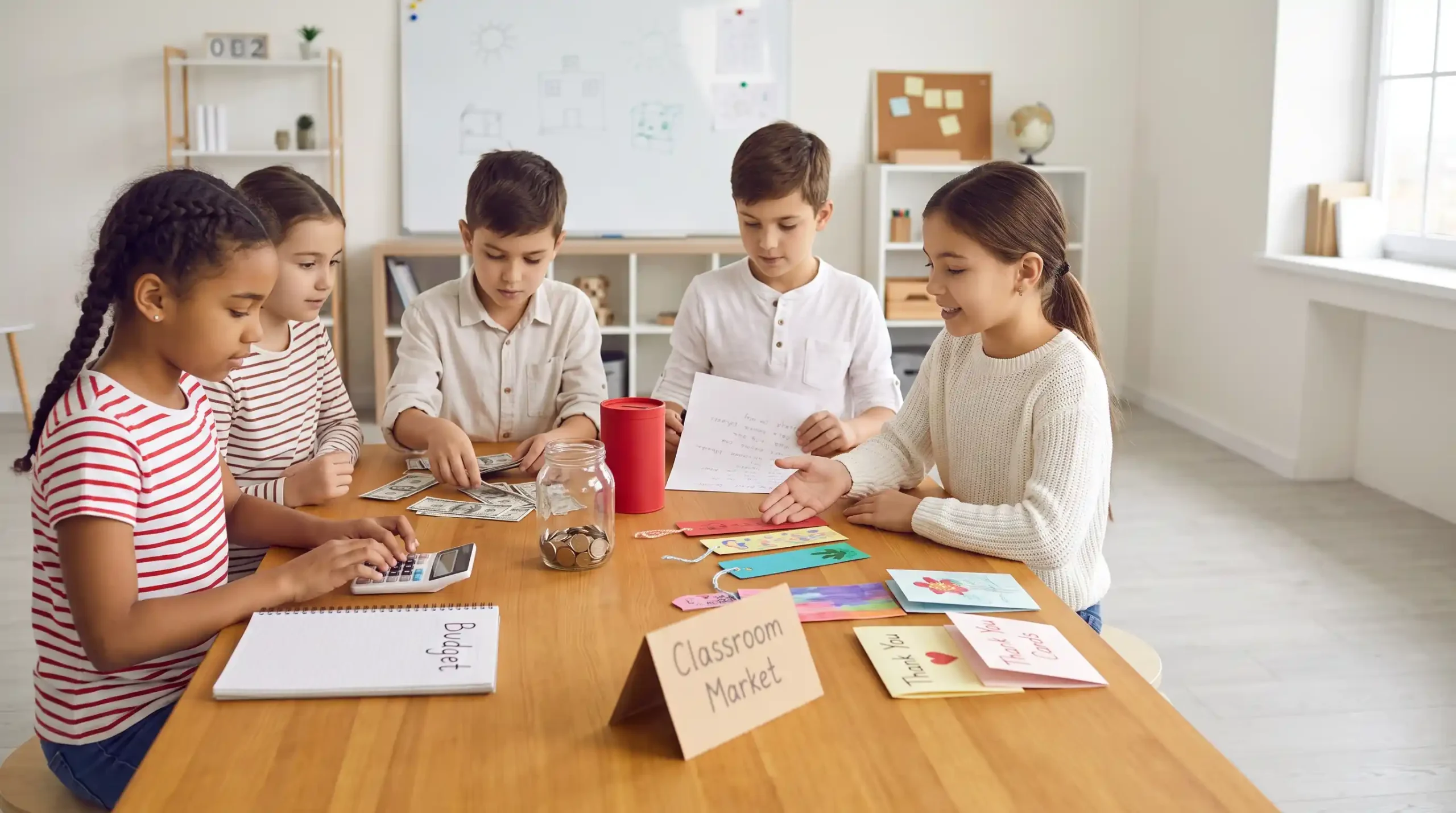
From Pocket Money to Profit: Teaching Kids Basic Business Skills