

Best Kids Entrepreneur Ideas From Home and School
Good business ideas for kids are simple, safe, and creative. Explore handmade products, pretend shops, inventions, school projects, digital creativity, and problem-solving activities that help children build real-world skills.
Good business ideas for kids are simple, safe, and creative. Think handmade cards, bookmarks, pretend shops, inventions, and school projects. Entrepreneurship does not need a company or big money. It can start with one question: "What can I make that helps, entertains, or solves a problem for someone?"
The goal is not to earn money. It is to build creativity, communication, problem-solving, teamwork, and confidence. Kidspreneur focuses on hands-on learning for children aged 7 to 15, using real-world projects.
Quick Answer: Easy Business Ideas for Kids
| Idea | Where | Skills Built |
|---|---|---|
| Handmade greeting cards | Home / School | Creativity, design |
| Bookmarks and stationery | Home / School | Product design, pricing |
| Pretend shop | Home / Class | Communication, money skills |
| Handmade crafts | Home / School | Creativity, patience |
| Digital artwork | Home | Digital creativity |
| Imaginary food brand | Home / School | Branding, marketing |
| Plant-care helper | Home | Responsibility |
| Educational activity kit | Home | Planning, teaching |
| School event stall | School | Teamwork, speaking |
| Problem-solving invention | Home / School | Innovation |
| Photography project | Home / School | Observation |
| Board game design | Home | Creativity, money skills |
The right idea depends on your child's age, interests, supervision, and school or family rules.
Why Should Kids Try Entrepreneurship?
Your child does not have to become a business owner. These projects help them practise:
- Creative thinking and problem-solving
- Communication and leadership
- Decision-making and planning
- Teamwork
- Money awareness
- Presenting ideas
- Handling feedback and mistakes
15 Best Business Ideas for Kids
Handmade Greeting Cards
Kids can make cards for birthdays, Eid, thank-yous, teachers, or friends. They can use drawing, paper cutting, stickers, recycled materials, or digital designs. They learn design, presentation, and basic pricing.
Handmade Bookmarks
Use cardboard, paper, ribbon, drawings, or quotes. Ask who would use the bookmark, what makes it different, and what materials it needs.
Pretend Shop
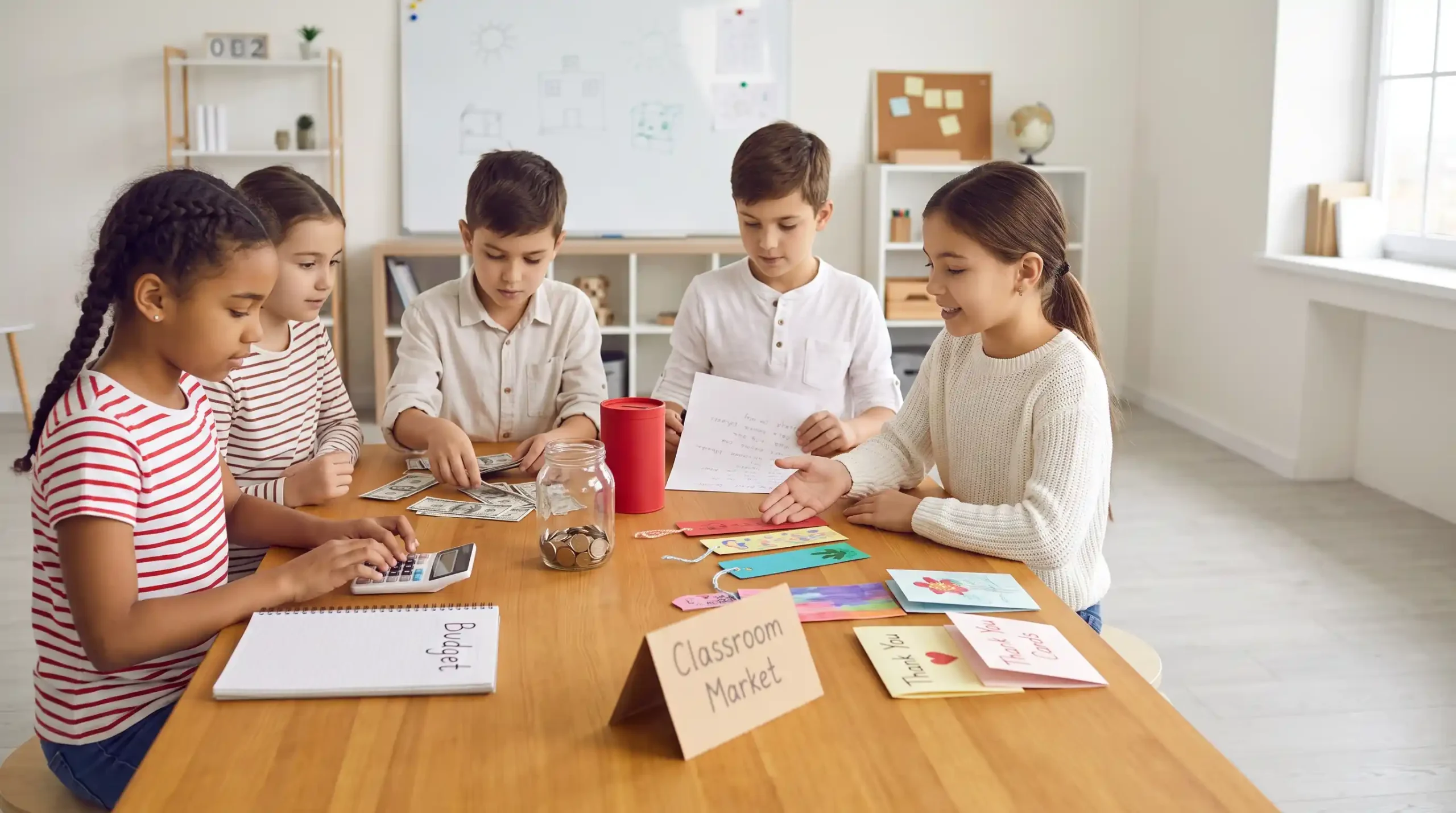
Turn a table or classroom corner into a store. Create a business name, price tags, signs, play money, and special offers. It teaches communication, pricing, and customer service.
Handmade Crafts
Try bracelets, keychains, paper flowers, mini paintings, or ornaments. Ask who might enjoy the product and how it could become more useful.
Imaginary Food Brand
Create an imaginary food company without making real food. Design its logo, packaging, slogan, target customer, pretend price, and advertisement.
Mini Plant-Care Helper
Older kids can help family members water plants, label them, or create care reminders with adult supervision. Focus on responsibility and organization.
Digital Artwork
Children interested in technology can create posters, wallpapers, greeting-card designs, or logo ideas. The process is simple: Create → Improve → Present → Get Feedback.
School Stationery Brand
Imagine a brand selling notebooks, bookmarks, pencil labels, study cards, or planners. Design its name, logo, and packaging as a classroom simulation.
Educational Activity Kit
Create a kit around science, mathematics, vocabulary, puzzles, or environmental awareness. Combine education, creativity, and product design.
Invention That Solves a Problem
Ask what could work better at home or school. Think about lost pencils, messy bags, or untidy desks. Then design, build, test, and improve a prototype.
Mini Photography Project
A themed project such as "My City Through My Eyes" develops observation, storytelling, and basic editing. Older kids can build a simple portfolio.
Family Problem-Solving Project
Children can spot problems such as messy books, unlabelled boxes, or a missing homework corner and propose a practical solution.
School Event Stall
With school approval and adult supervision, teams can create stalls featuring bookmarks, art, quizzes, crafts, or science demonstrations.
Simple Board Game
Children can design the goal, rules, cards, and board. A game like "Money Mission" can introduce spending, saving, needs, wants, and unexpected costs.
Mini Business Challenge
Ask older kids to create a product that solves a problem for students. They can research the user, build a prototype, estimate costs, design an advert, present it, and improve it using feedback.
Business Ideas by Age
| Age | Ideas |
|---|---|
| 5–7 | Pretend shop, drawing products, simple crafts, play money |
| 8–10 | Bookmarks, greeting cards, product designs, simple budgeting |
| 11–13 | Mini brands, prototypes, school projects, pricing exercises |
| 14–15+ | Market research, digital projects, business models, presentations |
Best Business Ideas for Kids at Home
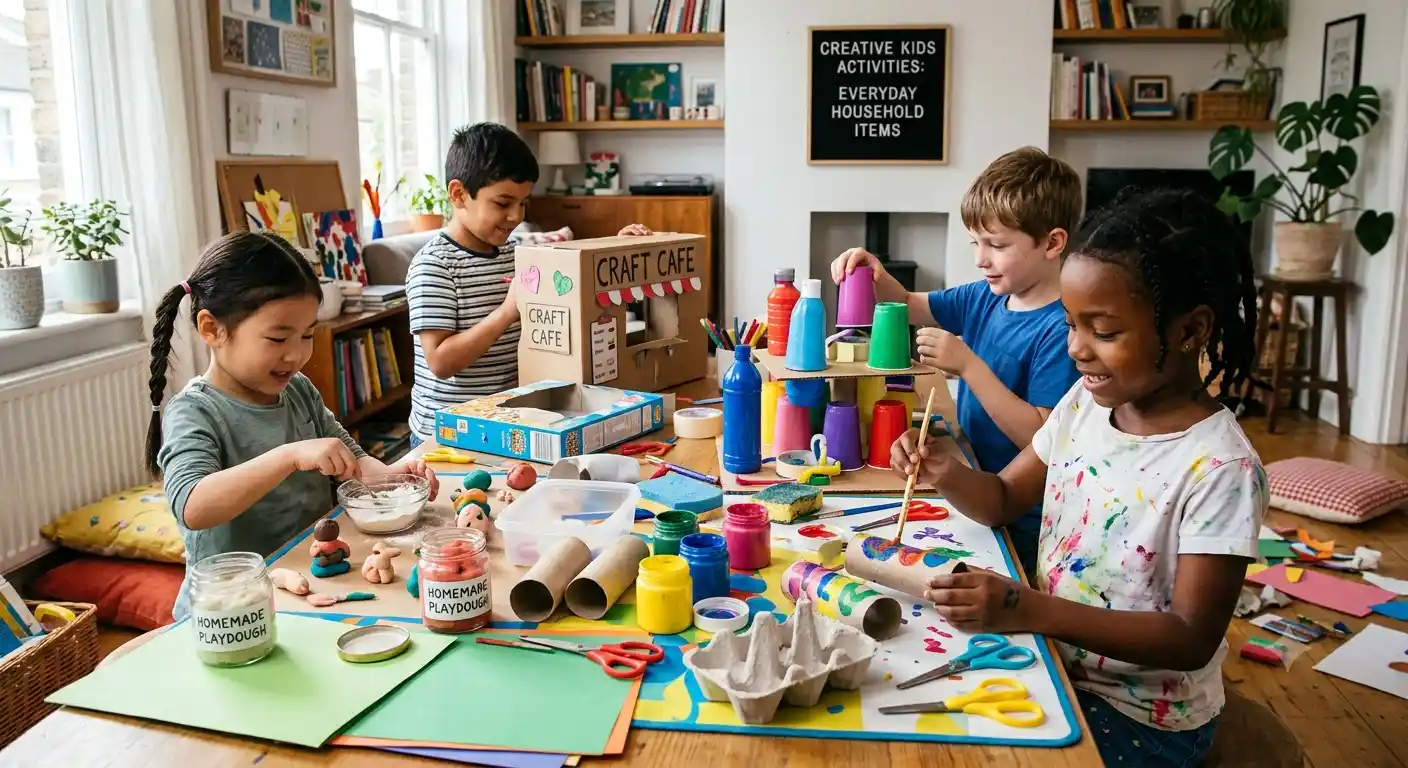
Many Kidspreneur activities use ordinary household items for creative projects.
Best Business Ideas for Kids at School
Classroom Activities
- Classroom pretend shop
- Craft projects
- Educational games
- Business simulations
Creative Challenges
- Product design challenges
- Innovation competitions
- Mini marketing campaigns
- Group invention projects
How to Choose the Right Business Idea
Start with your child's curiosity. Do not push an idea just because it sounds profitable.
Should Kids Make Real Money?
Not necessarily. Kids can learn creating, pricing, costing, advertising, and budgeting through pretend businesses.
If a child takes part in real selling, adults should supervise the activity and make sure it follows school, family, platform, and applicable local rules.
How Parents Can Help
Do not run the project for your child. Ask questions that encourage independent thinking.
- "What problem are you solving?"
- "Who would use this?"
- "Why would they want it?"
- "What would it cost to make?"
- "How could you make it better?"
- "What did you learn?"
Let Kids Make Mistakes
A design may look different than planned. A pretend customer may not like it. The price may be unrealistic. That is part of learning.
Experimenting, testing, receiving feedback, and improving teaches children that mistakes can become useful information.
5 Questions Every Young Entrepreneur Should Ask
From Idea to Mini Business: 5 Steps
The Learning Is the Real Product
Bookmark
Design, materials, customers, pricing, and communication.
Invention
Observation, problem-solving, prototyping, and testing.
Pretend Shop
Money, communication, organization, and decision-making.
How Entrepreneurship Connects to School Subjects
Explore More Children's Learning Resources
Creativity, confidence, curiosity, and teamwork matter as much as entrepreneurship. Explore more child-development and educational resources through the School of Scholars Knowledge Hub.
Visit School of Scholars Knowledge Hub →Frequently Asked Questions
What are the best business ideas for kids?
Handmade crafts, greeting cards, bookmarks, pretend shops, educational games, digital art, inventions, and school projects are accessible options. The best choice depends on the child's age and interests.
What is an easy business idea for a child?
A pretend shop, greeting cards, bookmarks, or a simple craft project can be an easy starting point. Kids can learn design, pricing, and customer thinking without complicated setup.
Can kids start a business from home?
Yes, with appropriate supervision. Crafts, artwork, educational products, and digital designs can all be explored at home while keeping activities age-appropriate.
What are good business ideas for kids at school?
Classroom simulations, craft projects, educational games, innovation challenges, product-design projects, and approved event stalls can introduce entrepreneurship.
Do kids need money to start?
No. Paper, cardboard, stationery, recycled materials, and digital tools can be enough. Pretend money can also teach pricing and budgeting.
What can kids learn from business projects?
Children can develop creativity, problem-solving, communication, teamwork, decision-making, planning, money awareness, presentation skills, and resilience.
What age can kids start learning entrepreneurship?
Young children can start with play-based activities. More structured projects can be introduced as children develop communication, teamwork, and independent problem-solving skills. Kidspreneur's core programs focus on ages 7 to 15.
How can parents encourage entrepreneurship?
Give children small challenges, ask open questions, encourage them to identify problems, let them design solutions, and allow them to learn from mistakes.
Should kids focus on making money?
No. Learning should come first. Concepts such as cost, price, saving, and profit can be introduced gradually as children become ready.
Can entrepreneurship help in other careers?
Yes. Creativity, communication, problem-solving, initiative, and teamwork are transferable skills that can be useful across many educational and career paths.
Start Small. Create. Test. Learn.
The best business ideas for kids can start with a piece of paper, a cardboard box, a simple problem, or an interesting question.
Let children discover problems, imagine solutions, create something, test it, get feedback, and improve it.
Start with an idea. Build it. Test it. Learn from it. Improve it.
Search
Recent Posts
12 October, 2026
From Pocket Money to Profit: Teaching Kids Basic Business Skills