In today’s rapidly evolving world, academic knowledge alone is no longer enough to guarantee success. Employers and industries now value something deeper—emotional intelligence in children.
But what exactly is emotional intelligence, and how does it shape a child’s future career?
The answer is powerful. Emotional intelligence (EQ) influences how children communicate, handle stress, solve problems, and lead others. These are the exact skills that determine long-term success in any profession.
At Kidspreneur Club, emotional intelligence is not treated as an extra skill—it is a foundation. Through hands-on learning and real-world interaction, children develop the ability to understand themselves and others.
In this blog, we will explore how emotional intelligence shapes a child’s career and why it is more important than ever.
What is Emotional Intelligence?
Emotional intelligence refers to the ability to:
Understand your emotions
Manage your reactions
Recognize others’ feelings
Build healthy relationships
Psychologists often divide emotional intelligence into five key components:
1. Self-Awareness
Understanding your emotions and how they affect your behavior.
2. Self-Regulation
Managing emotions, especially in stressful situations.
3. Motivation
Staying driven and focused despite challenges.
4. Empathy
Understanding and sharing others’ feelings.
5. Social Skills
Communicating and interacting effectively with others.
These skills begin developing in childhood and directly impact career success later in life.
Why Emotional Intelligence Matters More Than IQ
For decades, intelligence quotient (IQ) was considered the key to success. However, modern research shows that emotional intelligence plays an even bigger role.
Comparison Table: IQ vs Emotional Intelligence
Factor
IQ (Intelligence Quotient)
EQ (Emotional Intelligence)
Focus
Academic ability
Emotional & social skills
Measured By
Tests & exams
Behavior & interactions
Role in Success
Limited
High impact
Career Growth
Technical roles
Leadership & teamwork
Adaptability
Low
High
A child with high IQ may excel in exams, but a child with strong EQ excels in life.
The Science Behind Emotional Intelligence
Neuroscience reveals that emotional intelligence is linked to the prefrontal cortex—the part of the brain responsible for decision-making and behavior control.
What Happens in the Brain:
Emotional regulation strengthens neural pathways
Social interaction enhances cognitive flexibility
Empathy activates mirror neurons
These processes improve:
Decision-making
Stress management
Relationship building
This is why children with high emotional intelligence perform better in real-world situations.
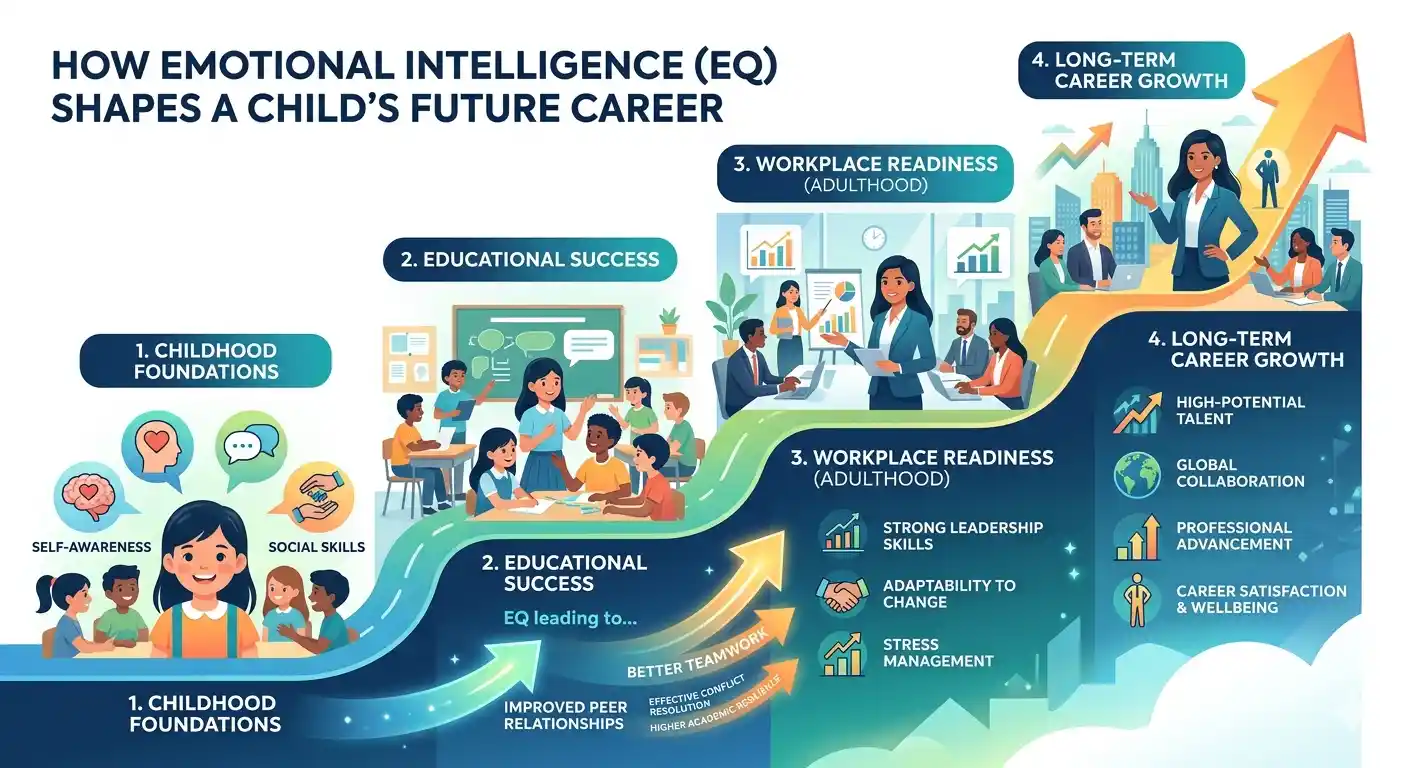
How Emotional Intelligence Shapes a Child’s Future Career
1. Better Communication Skills
Children with high EQ can express ideas clearly and listen effectively key skills in every career.
2. Strong Leadership Abilities
Leaders are not defined by knowledge alone but by their ability to understand and guide others.
3. Effective Problem Solving
Emotionally intelligent children stay calm under pressure and think rationally.
4. Teamwork and Collaboration
Modern workplaces require teamwork. EQ helps children work well with others.
5. Adaptability in Changing Environments
Careers today evolve quickly. Emotional intelligence helps children adjust and grow.
6. Confidence and Decision-Making
Children trust their decisions and take initiative.
Real-Life Example
Scenario: Handling Failure
Low EQ Response: A child gives up after failing a task.
High EQ Response: A child reflects, learns, and tries again.
👉 Over time, the second child develops resilience—a key trait in successful careers.
Emotional Intelligence and Future Careers
In the age of automation and AI, technical skills can be replaced—but emotional intelligence cannot.
Careers That Strongly Depend on EQ:
Entrepreneurship
Leadership roles
Marketing & sales
Teaching & coaching
Management positions
Employers now prioritize soft skills alongside technical knowledge.
How Kidspreneur Builds Emotional Intelligence
At Kidspreneur Club, emotional intelligence is developed through experience—not theory.
Our Methods:
Group activities and teamwork
Real-world problem solving
Idea pitching sessions
Hands-on creative projects
Open discussions and feedback
For example, in the Summer Bootcamp 2026, children: