



10 AI-Inspired Kids Activities That Make Learning Fun
Fun, creative, and age-appropriate activities that introduce children to artificial intelligence, patterns, coding, problem-solving, creativity, and future-ready thinking.
But introducing children to AI doesn't mean sitting them in front of complicated programming lessons.
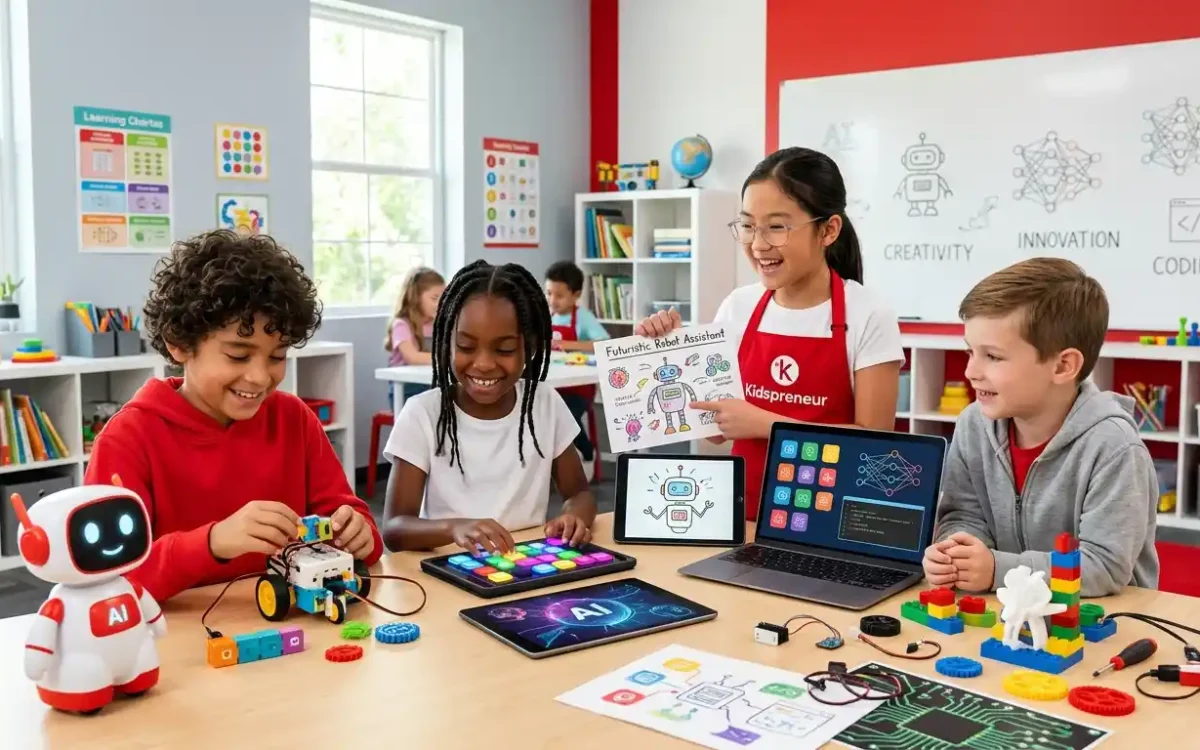
Kids can explore AI-inspired activities through games, storytelling, puzzles, experiments, creativity challenges, and simple coding projects. These activities can help children understand concepts such as patterns, instructions, data, decision-making, automation, and problem-solving in an age-appropriate way.
The goal isn't to make every child an AI engineer. Instead, AI-inspired activities can encourage children to become curious thinkers, creative problem-solvers, and confident technology users.
What Are AI-Inspired Kids Activities?
AI-inspired kids activities are educational games and projects that introduce children to ideas commonly associated with artificial intelligence.
For example, children can learn that computers can:
- Recognize patterns
- Follow instructions
- Sort information
- Make predictions
- Identify objects
- Respond to commands
- Learn from examples
- Generate creative outputs
Many of these concepts can be taught without using advanced technology.
A simple sorting game can demonstrate classification. A guessing game can introduce prediction. A robot made from cardboard can help children understand instructions and automation.
Play a Human “AI” Guessing Game
Start with a simple guessing game.
One child secretly chooses an object, animal, food, or place. The other player can ask questions to figure out what it is.
- Is it alive?
- Is it bigger than a book?
- Can you eat it?
- Is it usually found outdoors?
- Does it have four legs?
Afterward, explain that the game involves using information to narrow down possible answers.
Train a Pretend AI With Examples
Give your child several objects or pictures and ask them to create categories.
For example:
- Category A: Things that can fly
- Category B: Things that cannot fly
Give them pictures of birds, airplanes, cars, butterflies, dogs, and helicopters.
Then mix the pictures and ask: “Which category do you think this belongs to?”
Create a Rule-Based Robot
You don't need a real robot for this activity.
Choose one child to become the “robot.” The other child gives precise instructions.
For example:
- Take three steps forward.
- Turn left.
- Pick up the blue block.
The robot must follow the instructions exactly. Add obstacles to make the challenge more exciting.
Build an AI Story Generator
Create three random story elements.
- Character: Robot
- Location: Space station
- Problem: The lights suddenly stop working
Challenge your child to create a story using all three elements.
For older children, an age-appropriate AI writing tool can be explored with adult supervision. Compare the generated story with the child's own version.
Design a Smart Home on Paper
Ask children to imagine they are designing a smart home.
They can draw a house and add imaginary AI-powered features.
- Smart lights
- Automatic curtains
- Voice-controlled music
- Security sensors
- Smart garden watering
- Temperature control
Ask: “What problem does each smart feature solve?”
Create a Pattern Prediction Challenge
Pattern recognition is an important concept in computing and AI.
Create simple sequences such as:
Red → Blue → Red → Blue → ?
2 → 4 → 6 → 8 → ?
Older children can work with more complicated patterns involving shapes, numbers, or letters.
Ask them to explain why they think their answer is correct.
Design a Helpful AI Assistant
Ask children to invent their own imaginary AI assistant.
- Name: What is it called?
- Purpose: What does it help people do?
- Users: Who would use it?
- Features: What can it do?
- Problem: What problem does it solve?
One child might create an AI homework assistant while another might invent an AI garden assistant.
Play “Human vs. Machine” Classification
Create two piles of objects or pictures and give children a classification challenge.
For example: “Sort these foods into everyday foods and occasional foods.”
Discuss whether every example is easy to classify.
Ask: “What happens when something doesn't clearly belong to one category?”
Create an AI Art Prompt Challenge
For older children, introduce the idea of giving detailed instructions to an AI image-generation tool with adult guidance.
Instead of simply asking for:
“A robot.”
Ask children to describe:
- What the robot looks like
- Where it is
- What it is doing
- The environment
- The mood
- The colors
- The visual style
Compare how different instructions can produce different creative results.
Build a Future AI Business Idea
Combine AI learning with entrepreneurship.
Ask children to imagine they are creating a business that uses AI to solve a problem.
Their idea could involve:
- Education
- Environment
- Transportation
- Food
- Sports
- Agriculture
- Entertainment
Ask them to create:
- A business name
- A problem
- An AI-powered solution
- A target customer
- A simple logo
- A short pitch
Why AI Activities Are Useful for Children
AI-inspired activities can bring together multiple areas of learning.
A single activity might involve mathematics, communication, creativity, science, technology, and problem-solving.
Rather than teaching AI as a complicated technical subject, children can first understand the ideas behind it.
- What information do we have?
- What patterns can we find?
- What instructions should we follow?
- What prediction can we make?
- What problem are we trying to solve?
AI Learning Doesn't Always Need a Screen
Many foundational AI concepts can be taught without technology.
| AI Concept | Screen-Free Activity |
|---|---|
| Classification | Sort toys or pictures |
| Algorithms | Give step-by-step robot instructions |
| Prediction | Guess the next pattern |
| Data | Organize objects into categories |
| Decision-Making | Play a question-based guessing game |
| Automation | Create a pretend smart-home system |
| Problem-Solving | Invent a technology solution |
Encourage Children to Question AI
Learning about AI should include more than discovering what technology can do.
Children should also learn to ask questions about its limitations.
- Can AI make mistakes?
- Does AI always understand what people mean?
- Can information produced by AI be incorrect?
- Why should we check important information?
- Should we share personal information with AI tools?
These conversations can help children develop responsible digital habits.
Parents and teachers should supervise children's use of AI tools, choose age-appropriate platforms, and encourage children to question and verify AI-generated information.
Combine AI With Other Kids Activities
🎨 AI + Art
Design imaginary robots, smart cities, futuristic inventions, and creative digital concepts.
💡 AI + Entrepreneurship
Create businesses that use technology to solve real-world problems.
🔬 AI + STEM
Explore robotics, coding, experiments, engineering, patterns, and technology challenges.
How Parents Can Make AI Learning Fun
Parents don't need to be AI experts to encourage curiosity.
Start by asking questions rather than explaining everything.
“How do you think a computer could recognize a dog?”
“How could we teach a robot where to go?”
“What problem could AI help solve?”
“What could go wrong with your idea?”
“How would you improve it?”
AI Activities for Different Ages
Ages 5–7
Sorting games, pattern games, robot instruction games, guessing games, storytelling, and smart-home drawings.
Ages 8–10
Basic coding concepts, classification, AI-inspired puzzles, product invention, prompt-writing basics, and robotics challenges.
Ages 11–13
AI ethics, coding, robotics, data concepts, AI business ideas, research projects, and technology presentations.
The Future Starts With Curiosity
Children don't need to understand every technical detail of artificial intelligence today.
What matters is giving them opportunities to ask questions, experiment, solve problems, and create.
AI-inspired activities can help children understand that technology isn't simply something they consume. It can also be something they question, understand, design, and use responsibly.
Final Thoughts
AI education for children doesn't have to be complicated.
A guessing game can teach prediction. A sorting game can introduce classification. A pretend robot can demonstrate algorithms. A creative story can introduce generative AI. An imaginary business can combine entrepreneurship with technology.
The most important thing is to keep children actively involved.
Let them experiment, make mistakes, ask questions, and create their own ideas.
When learning feels like play, children can develop important future-ready skills while having fun.
AI isn't just about machines. It's also about helping young minds learn how to think, create, question, and solve problems.
Frequently Asked Questions
1. What are AI-inspired activities for kids?
AI-inspired activities are child-friendly games and projects that introduce concepts related to artificial intelligence, such as patterns, classification, prediction, algorithms, decision-making, and problem-solving.
2. What age can children start learning about AI?
Children can begin exploring basic AI concepts at a young age through simple games, sorting activities, patterns, storytelling, and robot instruction challenges. The complexity can increase as children grow.
3. Do kids need coding experience to learn about AI?
No. Many AI concepts can be introduced without coding. Screen-free activities such as classification games, prediction challenges, and step-by-step instruction games can provide a foundation for later technical learning.
4. How can AI activities improve children's learning?
AI-inspired activities can encourage logical thinking, creativity, problem-solving, communication, pattern recognition, experimentation, and digital literacy.
5. Should parents supervise children using AI tools?
Yes. Parents and educators should choose age-appropriate tools, supervise children's use of AI, avoid sharing sensitive personal information, and encourage children to verify important information instead of automatically trusting AI-generated answers.