



10 Fun AI Activities for Kids to Explore Artificial Intelligence.
Discover simple and engaging AI activities that help children understand artificial intelligence through games, creativity, coding, problem-solving, and hands-on exploration.
Because AI is becoming increasingly visible, children can benefit from learning what it is and how it works in an age-appropriate way.
But introducing artificial intelligence to kids doesn't have to mean starting with complicated programming or technical terminology.
Simple games and hands-on activities can introduce important AI concepts such as patterns, classification, instructions, data, prediction, decision-making, and machine learning.
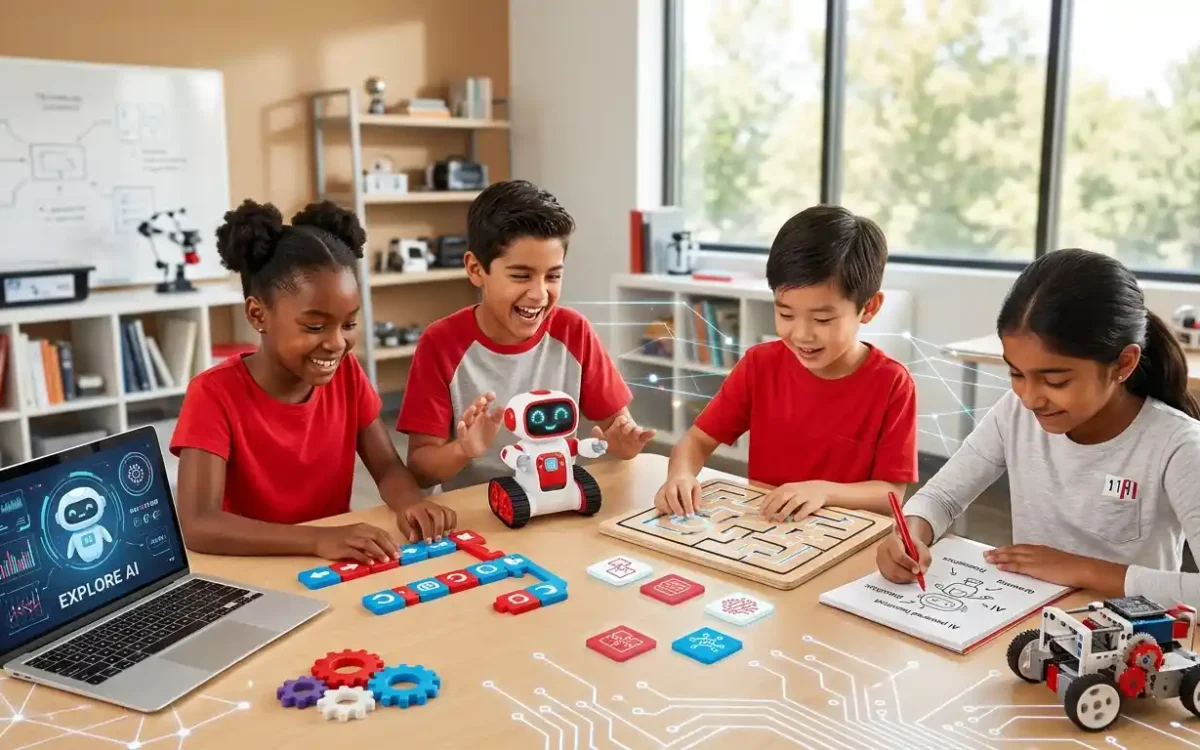
The following 10 AI activities for kids are designed to make artificial intelligence more approachable, interactive, and fun.
Why Should Kids Learn About Artificial Intelligence?
Children don't necessarily need to become programmers or AI engineers. However, understanding basic AI concepts can help them become more confident digital citizens.
AI education can encourage children to ask questions about how technology works rather than simply using technology without understanding it.
🧠 Critical Thinking
Children learn to question information, identify patterns, and think carefully about technology-generated results.
💡 Creativity
AI-inspired projects can encourage children to imagine new products, stories, inventions, and solutions.
💻 Digital Literacy
Children become more familiar with the concepts behind the intelligent technologies they encounter.
Teach a Human “AI” to Recognize Objects
Choose several everyday objects such as pencils, cups, toys, books, and spoons.
Ask one child to act as an “AI system.” Another child gives examples and explains how objects can be grouped.
For example, objects could be classified by shape, color, material, or purpose.
Play an AI Guessing Game
Think of an object, animal, food, or place and let children ask questions to identify it.
Then reverse the game. Let children imagine how a computer might use information from previous examples to make a guess.
Explain that some AI systems use patterns in data to make predictions.
Create a Human Decision Tree
Create a simple decision tree using questions.
For example:
- Is it alive?
- Does it have four legs?
- Can it fly?
- Does it live in water?
Children follow the questions until they reach a possible answer.
Train a “Robot” With Instructions
One child becomes the robot while another becomes the programmer.
The programmer must give precise instructions for the robot to complete a task.
Add obstacles to make the challenge more interesting.
If the robot performs the wrong action, children must identify which instruction needs to be changed.
Make an AI Story Generator
Give children three categories: character, location, and problem.
They randomly select one item from each category and create a story.
For example, they might combine a robot, a space station, and a broken communication system.
Explain how computers can combine information and patterns to produce outputs.
Build a Simple AI Chatbot on Paper
Children can create a pretend chatbot using paper cards.
Write possible questions on one set of cards and appropriate responses on another.
Children match questions with responses and gradually create a conversation system.
Design an AI-Powered Robot
Ask children to imagine a robot that uses artificial intelligence to solve a real-world problem.
It could help clean parks, assist farmers, guide visitors, organize classrooms, or help during emergencies.
Children can draw their robot and explain what information it would need to perform its job.
Spot Patterns Like an AI
Create sequences using numbers, shapes, colors, letters, or objects.
Ask children to identify what comes next.
Make the patterns increasingly challenging.
Explain that recognizing patterns is an important part of many computing and machine-learning systems.
Create an AI Art Challenge
Ask children to imagine artwork that combines unusual ideas.
For example: “A friendly robot exploring an underwater city.”
Children can draw their idea themselves or, where appropriate, use a parent- or teacher-supervised creative AI tool.
Discuss how a prompt or set of instructions influences an AI-generated result.
Become an AI Problem Solver
Give children a real-world problem and ask them to imagine how AI could help solve it.
Possible challenges include:
- How could AI help reduce food waste?
- How could AI help students study?
- How could AI help keep cities cleaner?
- How could AI help farmers?
- How could AI help people with disabilities?
Children then create a simple drawing, prototype, or presentation explaining their idea.
AI Activities for Kids Without Screens
Children don't need an AI application or computer to begin understanding artificial intelligence.
Many foundational concepts can be explored through offline games and physical activities.
- Pattern recognition games
- Classification challenges
- Decision-tree games
- Robot instruction games
- Prediction challenges
- Logic puzzles
- Algorithm games
- Data sorting activities
These activities are particularly useful for younger children because they introduce the underlying ideas without overwhelming them with technical terminology.
Teach Kids to Use AI Responsibly
Learning about artificial intelligence should also include conversations about responsible technology use.
Encourage children to ask questions about AI-generated information rather than automatically assuming it is correct.
Teach them not to share private or sensitive information with AI tools.
Remind them that AI can make mistakes and that important information should be checked with trusted sources or adults.
Encourage children to use AI as a learning and creativity tool, not as a replacement for their own thinking.
Benefits of AI Activities for Children
Well-designed AI learning activities can support several important skills.
Problem-Solving
Children learn to break challenges into smaller steps and explore possible solutions.
Logical Thinking
Games involving patterns, instructions, and decisions strengthen logical reasoning.
Creativity
AI-inspired invention and storytelling activities give children opportunities to develop original ideas.
Digital Literacy
Children gain a basic understanding of the technologies they encounter in everyday life.
Communication
Presenting AI ideas helps children explain complex concepts in simple language.
Innovation
Children can explore how emerging technology might be used to address real-world challenges.
How Parents Can Make AI Learning Fun
Parents don't need to be AI experts to introduce children to artificial intelligence.
Start with questions that connect technology to things children already know.
- How do you think a phone recognizes your face?
- How does a game decide what happens next?
- How might a computer recognize a picture?
- How could a robot know where to go?
- Can a computer always make the right decision?
These questions can turn ordinary moments into opportunities for curiosity and discussion.
Final Thoughts
Artificial intelligence may sound complicated, but children can begin exploring its basic ideas through simple, age-appropriate activities.
From classification games and pattern challenges to robot instructions, AI art, storytelling, and invention projects, children can discover that artificial intelligence is not simply about machines.
It is also about data, patterns, instructions, decisions, creativity, and problem-solving.
Most importantly, AI education should encourage children to remain curious and think for themselves.
The goal isn't to turn every child into an AI programmer. It's to help young learners understand technology, question it thoughtfully, and imagine how they can use it to create something meaningful.
Frequently Asked Questions
1. What are AI activities for kids?
AI activities for kids are age-appropriate games, projects, and experiments that introduce concepts such as patterns, classification, algorithms, prediction, data, robotics, and artificial intelligence.
2. What age can kids start learning about AI?
Children can begin exploring basic AI concepts through simple games and activities at a young age. Activities should become more detailed and technical as children develop their mathematical, logical, and computing skills.
3. Do children need coding skills to learn AI?
No. Children can learn foundational AI concepts through offline games involving patterns, classification, predictions, instructions, and decision-making before learning to code.
4. Can AI activities be done without a computer?
Yes. Many AI concepts can be explored without screens through sorting games, decision trees, pattern challenges, robot instruction games, prediction activities, and logic puzzles.
5. Why should kids learn about artificial intelligence?
Learning about AI can help children develop digital literacy, critical thinking, creativity, problem-solving, logical reasoning, and an understanding of how modern technology works.