



10 Mini Business Activities That Teach Kids Entrepreneurship
What if learning about business didn't feel like a lesson at all? These mini business activities let kids play at being creators, sellers, designers, and problem-solvers no real money involved, no real stakes, just enough pretend to make it feel real.
You don't need a real company or a business plan to get a kid thinking like an entrepreneur. A pretend shop, a handmade craft, a made-up service, or a silly family challenge does the job just fine.
These land especially well with Gen Alpha kids, who are already comfortable creating, presenting, and problem-solving in ways past generations weren't this just gives that instinct somewhere useful to go.
What Counts as a "Mini Business Activity"?
Basically, it's a scaled-down version of running a business — small enough for a kid to actually pull off in an afternoon.
Maybe they make a product, slap a pretend price on it, sketch out a logo, talk it up like an ad, or "sell" it out of a shoebox store. One or two business ideas at a time, nothing overwhelming.
Works just as well at home, in a classroom, at a birthday party, or as a rainy-day family activity.
Why Bother Teaching Kids This Stuff Early?
Entrepreneurship isn't really about money, not at this age. It's about noticing something's broken, thinking up a fix, trying it, and being okay when it doesn't quite work the first time.
Along the way, kids end up practicing:
- Creative thinking
- Problem-solving
- Communication
- Confidence
- Decision-making
- Working with others
- Planning ahead
- A first sense of how money works
- Basic marketing instincts
- Rolling with change
10 Activities Worth Trying
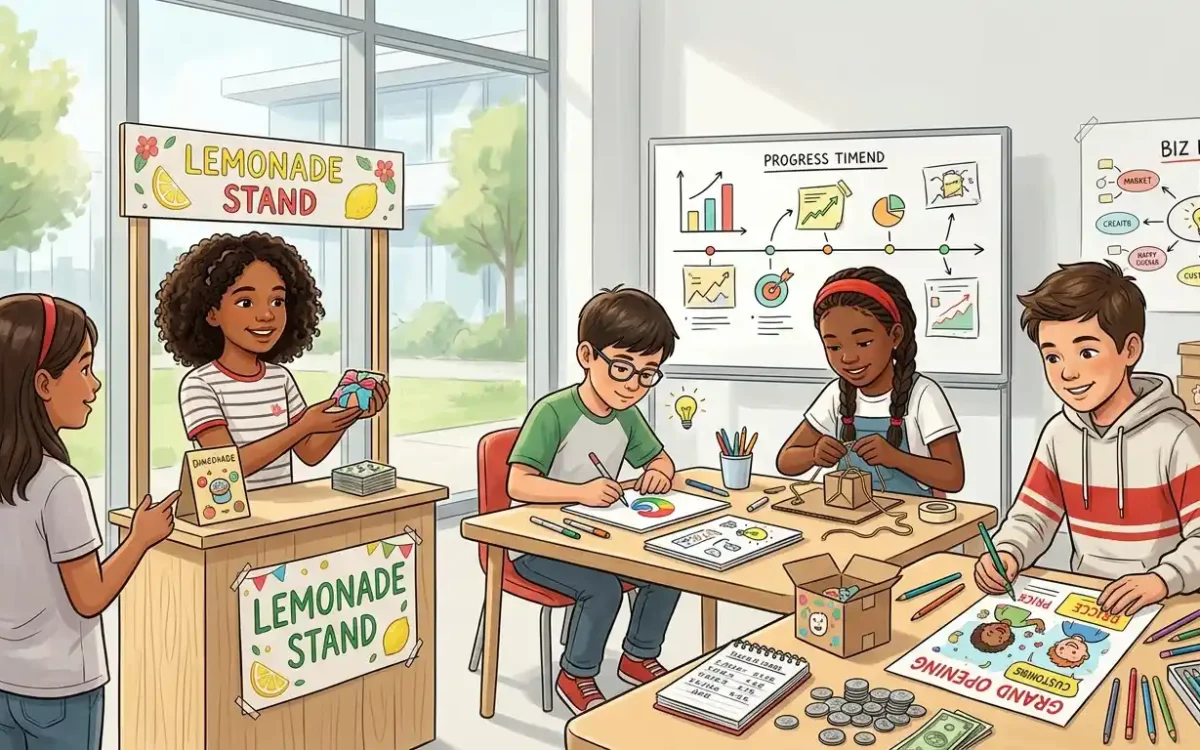
Set Up a Pretend Store
This one's the easiest entry point into all of it.
Let your kid pick out a handful of toys, books, handmade bits, or random household items to "stock" their store.
Then help them put together:
- A store name
- Names for each product
- Price tags
- A little handmade sign
- Maybe a special offer or two
Everyone else becomes a customer, paying with pretend money.
Launch a Handmade Product
Have them make something simple with cheap, safe materials — cards, bookmarks, little drawings, paper crafts, decorations, whatever they're into.
Then flip the frame: imagine this is actually going to be sold.
Ask:
- Who'd want this?
- What would you call it?
- What would it cost?
- What makes yours different?
Build a Mini Food Brand
Give them a food business to dream up — a made-up snack, juice, cereal, whatever sounds fun.
They design the name, the packaging idea, the logo, a slogan, and a pretend price tag.
Then ask who they think would actually buy it.
Invent Something That Fixes a Real Problem
Send them off to find one small annoyance — around the house, at school, anywhere.
Toys that never stay organized. Pencils that vanish. A backpack that digs into their shoulder.
Then challenge them to invent something that fixes it — a drawing, or a rough model made from cardboard, paper, blocks, whatever's around.
Run a Pretend Service Business
Not every business sells a "thing" — some just help.
Have your kid dream up a service instead. A few ideas to get them started:
- Plant-watering
- Organizing books
- Gift-wrapping
- Sorting school supplies
- A pretend pet-care setup
Ask them who'd actually need this and why.
Design a Logo and Slogan
Give them a made-up business and let them build its whole identity:
- A name
- A logo
- A slogan
- Packaging ideas
- A tiny ad
Then have them explain their choices — why that color, why that phrase.
It's a quiet way to show them that businesses are basically telling a story about themselves.
Play the Pricing Game
Line up a few pretend products and ask your kid to price each one.
Then talk through why some things cost more than others — materials, time, how useful it is, how well it's made, how much people actually want it.
Stick with pretend money for younger kids.
Run a Mini Marketing Campaign
Give them a pretend product and ask them to sell it — a poster, a slogan, a quick pitch, whatever they want to make.
Ask who it's aimed at. Kids? Parents? Teachers?
Then ask why their ad would actually land with that group.
Build a Business on a Small Budget
Hand them a made-up budget — say, 500 pretend dollars — and tell them they can't go over it while planning their mini business.
They'll need to decide how much goes toward materials, packaging, ads, and anything else.
It doesn't need to add up perfectly. The point is just getting them used to the idea that resources are limited and choices have trade-offs.
Host a Family Mini Business Fair
Combine a few of these into one bigger event.
Each kid builds a product or service and a short presentation, including:
- A business name
- A product or service
- A logo
- A price
- A promo message
- A short pitch
Parents and siblings play customer or pretend investor.
Wrap it up by celebrating different kinds of wins, not just one overall "winner."
Keeping It Fun Instead of Feeling Like Homework
These should feel like exploring, not another worksheet.
Start simple, and let the early attempts be a little messy — that's fine.
Instead of correcting an idea right away, try asking:
- Who'd use this?
- What problem does it solve?
- How could you make it better?
- What would actually get someone interested?
- What would you change after hearing feedback?
Questions like these get kids thinking for themselves instead of just waiting to be told the answer.
Turn Everyday Annoyances Into Business Ideas
One of the best ways to spark this kind of thinking is just getting kids to notice what's around them.
Try asking during the day:
It doesn't have to be a big problem.
Maybe their pencils are always a mess. Maybe cleaning up toys takes forever and they hate it.
Small stuff like that is exactly where good ideas come from.
Get Them Thinking About the Customer, Not Just Themselves
A product being cool to its creator doesn't automatically make it useful to anyone else — and that's a genuinely useful thing for a kid to learn early.
A few simple questions can plant that idea:
- Who needs this?
- What do they actually want?
- What problem do they have?
- Why would they pick your version?
No need to overcomplicate it beyond that.
Let Them Test Ideas and Actually Fix Them
Encourage your kid to show their idea to someone else and just... ask what they think.
Maybe the product's confusing to use. Maybe the logo doesn't make sense to anyone but them. Maybe the price is way off.
That's fine — that's the whole point.
They tweak it, try again, move on.
Matching the Activity to the Age
Ages 5–7
Keep it light — pretend shops, drawing products, simple logos, picking pretend prices.
Ages 8–10
Add prototypes, marketing posters, a few customer questions, basic budgeting, and short presentations.
Ages 11–13
Now you can bring in customer research, competitors, pricing strategy, marketing channels, and more structured pitches.
What's Actually Being Learned Here
A lot more than "business," honestly.
There's math in setting prices, writing in the ads, art in the logos, communication in the pitch, and critical thinking in solving whatever problem they picked. It ends up touching a bit of everything.
Why This Matters More for Gen Alpha Specifically
This generation is growing up alongside AI, automation, and jobs that barely existed a decade ago.
Whatever "career" looks like for them in twenty years probably won't look much like it does now.
Learning to spot problems, build solutions, explain ideas clearly, work with other people, and adapt when things change — that's a foundation that holds up no matter what the future actually looks like.
Mini business activities are just a fun, low-stakes way to start building that muscle early.
Don't Let It Turn Into a Contest
Not every idea's going to work, and that's the whole point of trying things.
If a kid feels like only the "best" idea counts, they'll stop taking creative risks fast.
Spread the recognition around instead:
- Most creative idea
- Best problem-solving
- Best product design
- Best presentation
- Best marketing idea
- Best teamwork
- Best eco-friendly concept
Everyone walks away with something to feel good about.
Stretch It Into a Bigger Project
Once a kid's warmed up to the basics, string a few activities together into something longer:
- Spot a problem.
- Brainstorm solutions.
- Pick one.
- Design the product.
- Build a prototype.
- Pick a business name.
- Design a logo.
- Set a pretend price.
- Make an ad.
- Present the whole thing.
Suddenly they've walked through the entire journey from "idea" to "business," start to finish.
Where Kidspreneur Comes In
Entrepreneurship sticks best when kids actually get to experiment, build, and present — not just hear about it.
Structured programs and activities give them a space to build these skills while still having genuine fun.
The point was never teaching kids how a business runs, exactly. It's building curiosity, confidence, and the habit of seeing a problem as something worth solving instead of something to complain about.
Final Thoughts
Kids don't need a real company to start thinking like entrepreneurs.
A pretend store, a handmade craft, a made-up service, a marketing poster, or a family business fair — any of it works.
Start small. Give them a problem, let them chase a solution, and ask them to explain why it matters.
Mostly, just let them experiment without worrying about getting it "right."
Small Activities Can Spark Big Ideas
It all starts with curiosity. When kids get used to spotting problems, imagining fixes, explaining their thinking, and improving as they go, they're picking up skills that go way beyond a pretend business game.
Today it's a mini business built out of cardboard and pretend money. Down the line, the creativity and confidence behind it could turn into something a lot more real.
Frequently Asked Questions
1. What are mini business activities for kids?
They're simple, kid-friendly entrepreneurship projects where kids play with ideas like products, services, customers, pricing, branding, and marketing through hands-on activities.
2. What do kids actually learn from them?
Creativity, communication, confidence, problem-solving, decision-making, teamwork, planning, a first sense of money, and thinking about what a customer actually wants.
3. What's a good first activity to try?
A pretend store is hard to beat as a starting point — naming products, setting pretend prices, talking to "customers," and making small decisions all come together in one easy setup.
4. Do kids need real money for any of this?
Not at all. Pretend money and made-up businesses can teach most of these concepts just fine without any real transactions involved.
5. How can parents keep this going at home?
Get kids noticing everyday problems, brainstorming fixes, building simple products or services, designing a brand, practicing a short pitch, and taking feedback without it feeling like criticism.