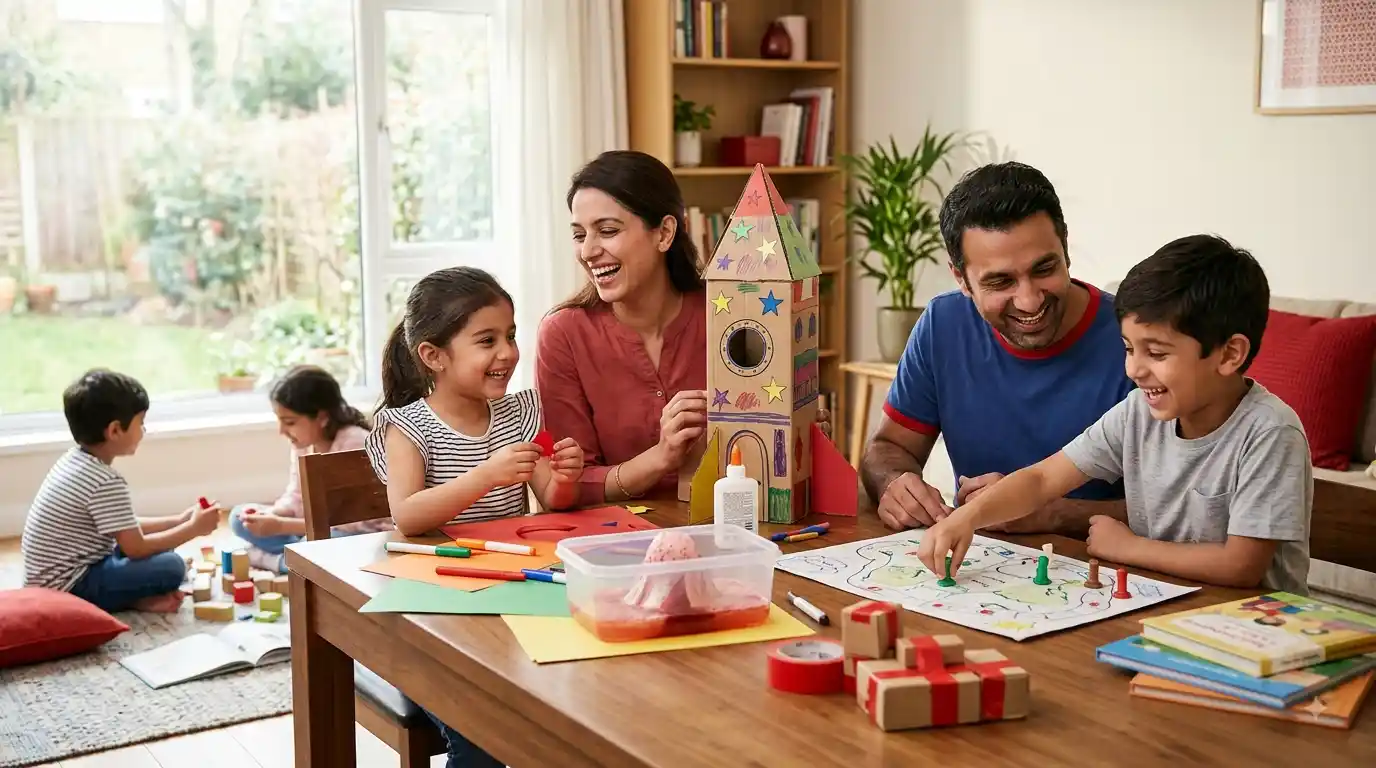





12 Creative Kids Activities Using Household Items
You don't need expensive toys or craft kits to keep children learning and entertained. Discover 12 creative kids activities using everyday household items that encourage imagination, problem-solving, teamwork, and practical skills.
Parents often assume that keeping children engaged requires a house full of toys, expensive craft supplies, or regular trips to entertainment centers. In reality, some of the most creative activities can begin with things already sitting around your home.
An empty cardboard box can become a rocket. A few paper cups can become a building challenge. Old newspapers can become an art project, while a few household objects can turn into a fun sorting or counting game.
These simple activities don't just keep children busy. They can also create opportunities to practice creativity, communication, problem-solving, teamwork, decision-making, and independence.
Why Use Household Items for Kids Activities?
Household-item activities have a major advantage: they are accessible. Families don't have to wait for a special shopping trip before starting.
They can also encourage children to think differently about ordinary objects.
When a child sees a cardboard box as more than a box, they are practicing imaginative thinking. When they figure out how to build something with limited materials, they are developing problem-solving skills.
Creative household activities can help children develop:
- Imagination
- Creative thinking
- Problem-solving
- Communication
- Fine motor skills
- Early mathematics
- Observation
- Teamwork
- Decision-making
- Confidence
- Independence
12 Creative Kids Activities Using Household Items
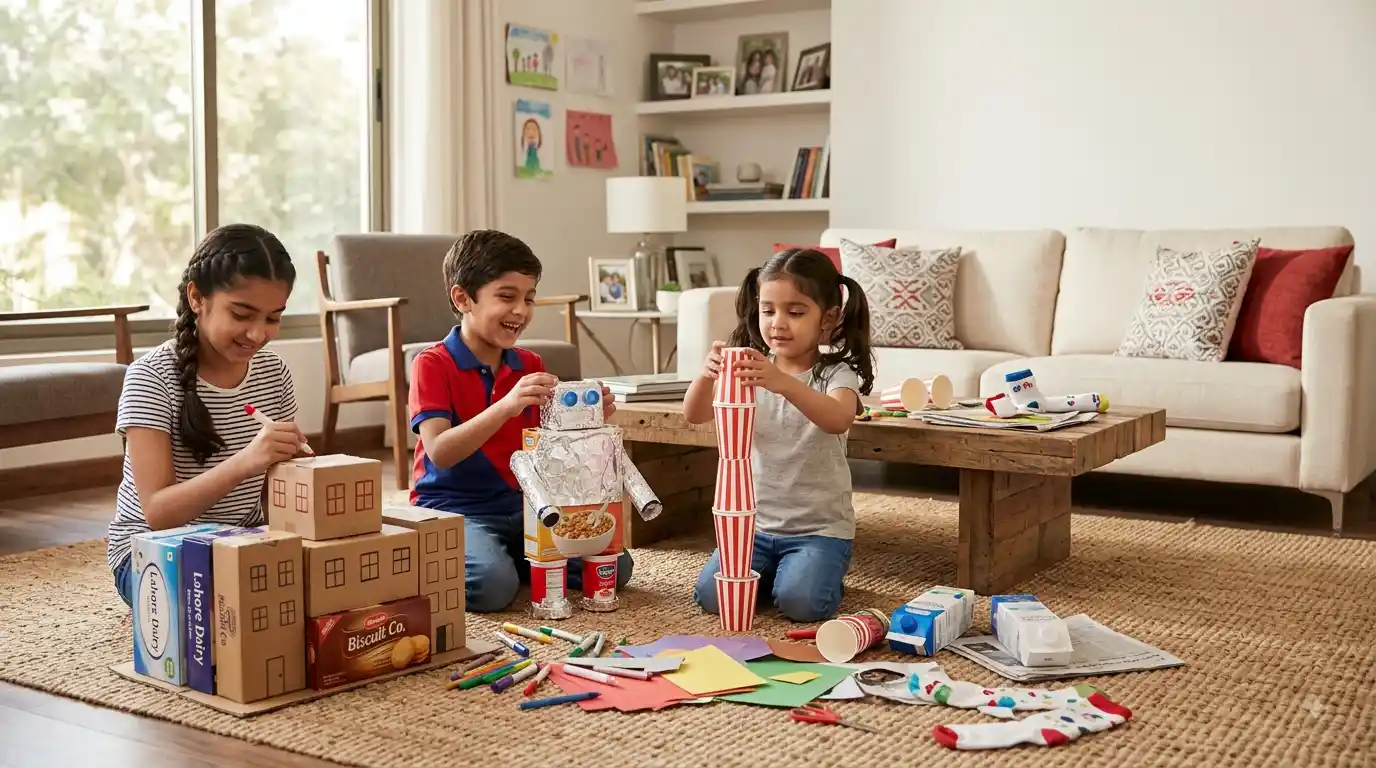
Build a Cardboard Box City
If you have empty cardboard boxes at home, turn them into a miniature city.
Children can create houses, shops, schools, roads, bridges, parks, and other buildings.
Encourage them to name their city and decide how people would live and work there.
Older children can even create a simple map showing where everything is located.
Create a Paper Cup Building Challenge
Paper or plastic cups can become a surprisingly challenging construction activity.
Challenge children to build the tallest tower they can.
Then introduce a new challenge: Can you build a structure that can hold a small toy?
Let children experiment with different designs rather than giving them the answer.
Make a DIY Sorting Game
Gather safe household objects with different colors, shapes, sizes, or textures.
Ask younger children to sort objects by color or size. Older children can create their own sorting rules.
You can also turn it into a timed challenge for an extra element of excitement.
Turn a Cardboard Box Into a Pretend Shop
Create a mini shop using empty, clean food packages, cardboard, paper signs, and pretend money.
Children can decide what their shop sells and create their own prices.
Take turns being the customer and shopkeeper.
Ask children questions such as: "What makes your shop special?" or "Why should customers buy this product?"
This simple game can introduce children to early concepts of entrepreneurship and business communication.
Create an Indoor Bowling Game
Turn an empty hallway or safe indoor area into a simple bowling lane.
Arrange the bottles like bowling pins and let children roll the ball toward them.
Older children can keep score and practice simple addition.
Always choose lightweight, safe objects and make sure the playing area is clear.
Make a Newspaper Art Challenge
Old newspapers can become creative materials instead of waste.
Ask children to create a collage, imaginary character, animal, city, or landscape.
You can also give everyone the same challenge and compare how differently each person approaches it.
Build a Spoon Catapult
With adult supervision, children can explore simple engineering concepts by building a safe miniature launcher.
The goal isn't to launch objects far. Instead, encourage children to experiment with design and observe how changing the angle affects movement.
Only use lightweight, soft objects and never aim anything at people, animals, faces, or fragile objects.
Create a Sock Puppet Theatre
Turn old clean socks into characters for a family puppet show.
Children can create characters and develop a short story.
Encourage them to perform the story for parents or siblings.
Older children can write dialogue and assign roles to different family members.
Make a Household Object Memory Game
Place several safe objects on a table and let children observe them for a short time.
Cover the objects with a cloth and secretly remove one.
Ask children to identify which object disappeared.
As children improve, increase the number of objects.
Create a DIY Obstacle Course
Use cushions, pillows, tape lines, and other safe household items to create a simple indoor movement course.
Children can walk along a line, move around cushions, crawl through a safe space, and complete different challenges.
Make sure there is enough space and remove anything that could cause an injury.
Design a Recycled Robot
Collect clean recyclable materials and challenge children to design their own robot.
Ask children to give their robot a name and decide what it does.
For example, one child might create a robot that helps clean rooms, while another creates a robot that teaches children.
Let them present their invention to the family.
Create a Family Challenge Jar
Use a clean jar, bowl, or container and fill it with small activity ideas written on pieces of paper.
Ideas could include:
- Tell a funny story.
- Build something with cardboard.
- Draw an imaginary animal.
- Name five things that are red.
- Create a new game.
- Act like an animal.
- Invent a new product.
- Tell a family member something you appreciate about them.
Whenever children are bored, let them choose a challenge from the jar.
How Household Activities Turn Everyday Objects Into Learning Tools
One of the most valuable lessons children can learn from these activities is that learning doesn't only happen with traditional educational toys.
A cardboard box can teach design. Cups can teach balance. Socks can support storytelling. Household objects can teach sorting and classification. Recycled materials can introduce sustainability.
The learning comes from what children do with the objects, not simply from the objects themselves.
How Parents Can Encourage More Creativity
When children are completing an activity, try not to provide the solution immediately when they face a problem.
Instead, ask questions that encourage them to think.
- What do you think we should try?
- What could we change?
- Is there another way to build it?
- What happens if we use a different material?
- How could we make your idea better?
These questions encourage children to become active problem-solvers.
Don't Aim for Perfection
A child's creation doesn't need to look perfect. The goal is not to produce something worthy of a display shelf.
The real value is in the process: experimenting, making mistakes, trying again, and explaining ideas.
Household Activities Can Teach Sustainability
Reusing household items for creative projects can also introduce children to the idea of reducing waste.
Instead of throwing away every cardboard box or clean container, families can think about whether it can be reused for play or learning.
This can help children understand that everyday materials can have more than one purpose.
Using Household Activities to Build Entrepreneurial Thinking
Creative activities can also become opportunities to introduce entrepreneurship at an age-appropriate level.
For example, after a child creates a cardboard invention, ask:
- What problem does your invention solve?
- Who would use it?
- What would you call it?
- How would you explain it to a customer?
- What makes your invention different?
These simple questions help children practice creativity, communication, decision-making, and value creation.
Age-Appropriate Household Activities
For Preschoolers
Try simple sorting, drawing, storytelling, stacking, pretend play, and supervised sensory activities using safe, large household objects.
For Children Ages 5–7
Introduce building challenges, simple crafts, memory games, pretend shops, counting activities, and storytelling games.
For Children Ages 8–12
Give children more complex challenges such as invention projects, DIY board games, product-design challenges, science activities, and creative problem-solving tasks.
Safety Comes First
Household materials should always be selected according to the child's age and abilities.
- Supervise young children closely.
- Avoid small objects around children who may put items in their mouths.
- Use child-safe art supplies.
- Be careful with scissors, tape, and other tools.
- Do not use broken glass or sharp objects.
- Keep chemicals, medicines, and cleaning products away from activities.
- Keep movement activities away from stairs and fragile furniture.
How Kidspreneur Encourages Learning Through Creativity
At Kidspreneur, children are encouraged to learn by exploring ideas, solving problems, creating, communicating, and experimenting.
Activity-based learning can help children explore areas such as:
- Entrepreneurship
- STEM
- Artificial intelligence
- Innovation
- Creativity
- Communication
- Leadership
- Sustainability
These experiences help children develop practical skills while encouraging curiosity and confidence.
A Simple Weekly Household Activity Plan
Families can make these activities part of their regular routine. Here's a simple example:
- Monday: Cardboard building challenge
- Tuesday: Sorting and memory game
- Wednesday: Art activity
- Thursday: Pretend shop
- Friday: DIY obstacle course
- Saturday: Recycled robot challenge
- Sunday: Family storytelling and challenge jar
You can repeat activities with new challenges so children don't feel like they are doing the same thing every week.
Final Thoughts
You don't need a large budget or a dedicated playroom to create meaningful experiences for children.
Everyday household objects can become tools for creativity, exploration, learning, and family bonding.
The next time your child says they are bored, look around the house before buying something new.
A cardboard box, a few cups, an old newspaper, some clean recyclable materials, or even a pair of socks could become the beginning of an exciting new adventure.
Everyday Items Can Create Extraordinary Learning
Children don't always need more things. Sometimes they simply need the freedom to imagine what ordinary things could become.
Give children simple materials, ask interesting questions, and let their creativity take the lead.
A little imagination can turn an ordinary afternoon at home into a meaningful learning adventure.
Frequently Asked Questions
1. What are some creative kids activities using household items?
Children can build cardboard cities, create recycled robots, make sock puppets, play sorting games, build cup towers, create pretend shops, design art projects, make obstacle courses, and play memory games using safe household materials.
2. What household items can children use for activities?
Safe household materials such as cardboard boxes, paper cups, newspapers, clean recyclable containers, paper, crayons, clean socks, cushions, and toys can be used for many creative activities. Materials should always be age-appropriate.
3. Are household activities good for children's development?
Yes. Creative household activities can support problem-solving, imagination, communication, fine motor skills, coordination, teamwork, observation, decision-making, and confidence.
4. How can household activities teach children entrepreneurship?
Activities such as pretend shops and invention challenges can introduce children to products, customers, communication, problem-solving, decision-making, creativity, and value creation in an age-appropriate way.
5. Are these kids activities suitable for different age groups?
Yes. Most activities can be adapted for different ages. Younger children can focus on simple sorting, building, drawing, and pretend play, while older children can work on inventions, design challenges, games, and more complex problem-solving tasks.
Search
Recent Posts
13 August, 2026
12 Creative Kids Activities Using Household Items
13 August, 2026
10 Fun Kids Activities for Rainy Days