

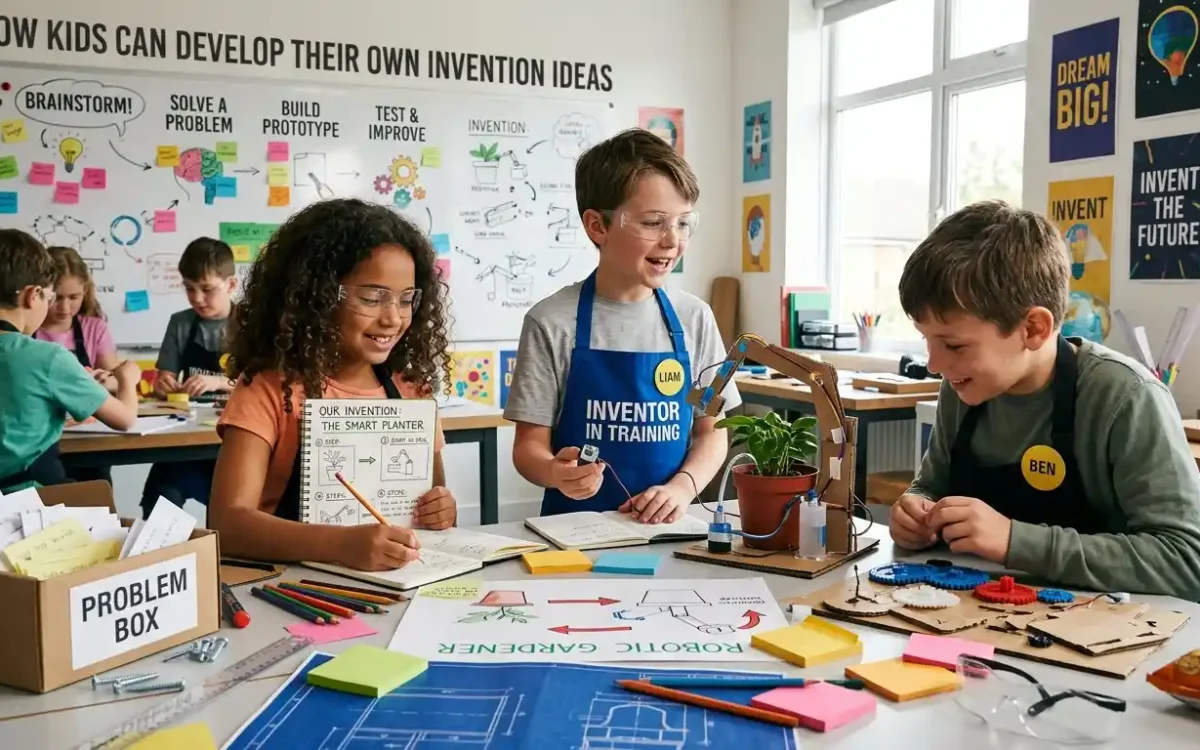
How Kids Can Develop Their Own Invention Ideas
Introduction
Every child has the ability to become an inventor. They naturally observe the world, ask questions, and imagine better ways of doing things. The real challenge is not creativity—it is guiding that creativity in the right direction.
Understanding how kids can develop their own invention ideas is important because it helps children move from simply using technology to actually creating solutions.
With the right environment and activities, any child can learn how to think like an innovator.
Why Invention Thinking Is Important for Kids
Children who learn invention thinking early develop stronger life skills, including:
- Creativity and imagination
- Problem-solving ability
- Critical thinking
- Confidence in expressing ideas
- Curiosity about how things work
- Early entrepreneurial mindset
These skills prepare them for future careers in science, technology, business, and design.
How Kids Can Spot Invention Opportunities
Before children can create inventions, they must learn to observe the world around them.
Encourage kids to look for:
- Problems at home
- Issues at school
- Daily frustrations
- Environmental challenges
- Things that feel “too complicated”
Step-by-Step Guide: How Kids Can Develop Their Own Invention Ideas
1. Observe Everyday Problems
The first step is simple observation.
Ask children:
- What annoys you daily?
- What takes too much time?
- What could be made easier?
This builds awareness and curiosity.
2. Ask “What If?” Questions
Creative thinking starts with imagination.
Examples:
- What if cleaning could be faster?
- What if we could save more water at home?
- What if homework was easier to organize?
These questions open the door to innovation.
3. Brainstorm Without Limits
Let children think freely without worrying about “right or wrong” ideas.
- Drawing ideas
- Talking through solutions
- Mixing different ideas together
This helps develop creative thinking skills for kids.
4. Build Simple Prototypes
Kids don’t need advanced tools to invent.
They can use:
- Cardboard
- Paper
- Bottles
- Tape
- Household items
Building small models helps bring ideas to life.
5. Test and Improve Ideas
Every invention improves over time.
- Test their idea
- Find what works and what doesn’t
- Make changes
- Try again
This builds resilience and problem-solving skills.
6. Add Creativity and Design
Inventions should not only work—they should also be creative.
- Add colors
- Improve design
- Make it user-friendly
- Think about how others will use it
This develops innovation thinking.
7. Share Their Ideas
Encourage children to explain their inventions to family or friends.
- Describe the problem
- Explain the solution
- Show how it works
This builds communication and confidence.
Skills Developed Through Invention Thinking
When children learn how kids can develop their own invention ideas, they gain:
Innovation Mindset
Learning to think creatively and identify opportunities.
Logical Reasoning
Developing structured thinking and analysis.
Confidence
Feeling comfortable sharing and presenting ideas.
Leadership Skills
Taking initiative and guiding projects.
Problem-Solving
Finding practical solutions to real-world challenges.
STEM Understanding
Applying science, technology, engineering, and math concepts.
Real-Life Examples of Kids’ Invention Ideas
Children can create simple yet powerful inventions like:
- Homework reminder boards
- Water-saving devices
- Recycling organizers
- Toy storage systems
- Study desk improvements
Even small ideas can solve big problems.
How Parents and Teachers Can Support Innovation
Adults play an important role in developing invention thinking.
They can help by:
- Encouraging curiosity
- Allowing experimentation
- Avoiding fear of failure
- Providing simple materials
- Asking open-ended questions
Supportive environments build confident young innovators.
Kidspreneur Approach to Innovation Learning
At Kidspreneur, we focus on teaching how kids can develop their own invention ideas through hands-on learning.
Our programs help children:
- Explore real-world problems
- Build creative solutions
- Learn STEM concepts
- Develop entrepreneurial thinking
- Gain confidence through projects
Our Learning Themes
The Oops Lab
Hands-on experiments and engineering challenges.
Time Travel with AI
Future technology exploration for kids.
Eco Smart Kids
Sustainable innovation and environmental problem-solving.
Little Masters Studio
Creative thinking through art and design.
Teaching children how kids can develop their own invention ideas is one of the best ways to prepare them for the future. It helps them move from passive learning to active creation.
When kids learn to observe, imagine, build, and improve, they become confident problem-solvers and future innovators.
Every big invention starts with a small idea—and every child has that potential.
❓ FAQs
1. How can kids start developing invention ideas?
By observing problems, asking questions, and thinking of creative solutions.
2. Do kids need expensive tools to invent?
No, most inventions can be created using simple household materials.
3. Why is invention thinking important for children?
It builds creativity, confidence, and problem-solving skills.
4. Can all kids become inventors?
Yes, every child has the potential to become an innovator with practice.
5. How does Kidspreneur help with invention learning?
Kidspreneur offers STEM, AI, and creativity-based programs for hands-on innovation learning.