

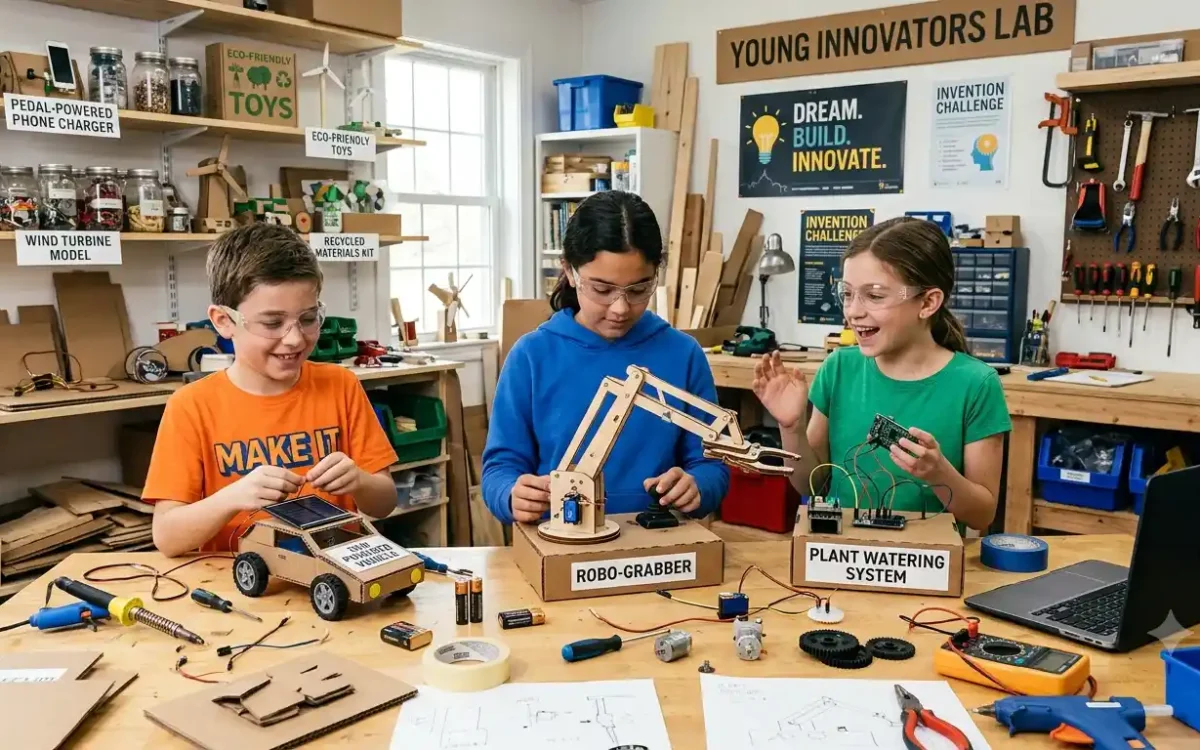
DIY Invention Ideas for Young Innovators: Creative Projects That Build Future Skills

DIY Invention Ideas for Young Innovators
7
Jul
2026

DIY Invention Ideas for Young Innovators: Creative Projects That Build Future Skills

Introduction

Every great invention starts with one simple idea.

From the light bulb to smartphones, history is filled with inventions that began with curiosity and a willingness to solve everyday problems. Children naturally ask questions, experiment with ideas, and imagine creative solutions, making childhood the perfect time to encourage innovation.

Exploring DIY invention ideas for young innovators helps children think like inventors while developing valuable life skills. Instead of simply consuming technology, they learn how to create, design, test, and improve their own ideas.

Whether your child dreams of becoming an engineer, entrepreneur, scientist, or designer, these invention projects can inspire a lifelong love for innovation.

Why DIY Invention Projects Matter

Hands-on invention activities offer much more than entertainment.

They encourage children to:

  • Think creatively
  • Solve real-world problems
  • Improve critical thinking
  • Build confidence
  • Learn STEM concepts
  • Develop engineering skills
  • Practice teamwork
  • Build resilience through trial and error

Children also discover that making mistakes is an important part of innovation.

Skills Children Develop Through DIY Inventions

Skill How DIY Projects Help
Creativity Encourages original thinking and imagination.
Problem-Solving Helps children identify challenges and create solutions.
STEM Learning Introduces science, technology, engineering, and mathematics naturally.
Communication Explaining ideas improves speaking skills.
Leadership Managing projects builds responsibility.
Entrepreneurial Thinking Children learn how ideas become products.

15 DIY Invention Ideas for Young Innovators

1. Create a Cardboard Vending Machine

Build a vending machine using cardboard, rubber bands, and paper cups while learning engineering, planning, and design thinking.

2. Build a Mini Water Filter

Use sand, cotton, gravel, and plastic bottles to create a simple filtration system while exploring environmental science.

3. Design a Smart Pencil Holder

Create a desk organizer with useful features like a phone stand, sticky note holder, or charging cable slot.

4. Invent a Toy Using Recycled Materials

Transform bottle caps, cardboard, and recycled containers into a completely new toy.

5. Build a Balloon-Powered Car

Learn about air pressure, motion, and engineering through one of the most popular STEM activities.

6. Create a Rainwater Collection Model

Design a model showing how rainwater can be collected and reused efficiently.

7. Invent a Homework Organizer

Create an organizer that keeps books, stationery, and schedules neat and accessible.

8. Design a Marble Maze

Build an exciting maze using cardboard and straws to improve planning and logical thinking.

9. Build a Solar Oven Model

Use cardboard, aluminum foil, and plastic wrap to learn about renewable energy.

10. Invent a Better Lunch Box

Encourage children to design a lunch box that solves everyday school challenges.

11. DIY Robotic Hand

Build a moving robotic hand using drinking straws, cardboard, and string.

12. Automatic Plant Watering System

Create a simple self-watering system using recycled plastic bottles.

13. Invent a Home Safety Device

Design products like door reminders, toy organizers, or night-light holders to improve home safety.

14. Build a Bridge Challenge

Construct the strongest bridge possible using paper or popsicle sticks while learning structural engineering.

15. Create an Invention That Solves a Daily Problem

Identify an everyday frustration and invent a creative solution just like real entrepreneurs do.

The Invention Design Process

Step Action
Observe Find a real-world problem.
Imagine Think of different solutions.
Design Draw or build the idea.
Test See if it works.
Improve Make changes and improve the invention.
Present Explain the invention to others.

This simple process mirrors how professional inventors and entrepreneurs create successful products.

Tips for Parents to Encourage Innovation

  • Encourage curiosity and questions.
  • Allow experimentation.
  • Celebrate mistakes as learning opportunities.
  • Provide recycled materials for projects.
  • Visit science museums.
  • Read about famous inventors.
  • Join invention competitions.
  • Ask children to explain their ideas.

Confidence grows when children know their ideas matter.

How Kidspreneur Helps Young Innovators

At Kidspreneur, innovation is part of every learning experience.

Our programs encourage children to:

  • Build inventions
  • Solve real-world challenges
  • Develop entrepreneurial thinking
  • Explore STEM education
  • Learn AI concepts
  • Improve creativity
  • Work in teams
  • Present innovative ideas confidently

Our Featured Programs

The Oops Lab (STEM Learning)

Hands-on science experiments, engineering activities, and invention challenges.

Time Travel with AI

Children discover artificial intelligence and future technologies through interactive projects.

Eco Smart Kids

Students create environmentally friendly inventions using sustainable materials.

Little Masters Studio

Creative design projects that strengthen imagination and innovation.

All Theme Bundle

A complete learning journey combining entrepreneurship, STEM, creativity, AI, and real-world problem solving.

Why Innovation Matters for the Future

The careers of tomorrow will require people who can:

  • Think creatively
  • Adapt quickly
  • Solve complex problems
  • Build new technologies
  • Create businesses
  • Lead innovation

Teaching children invention skills today prepares them for opportunities that may not even exist yet.

Innovation is becoming one of the most valuable future skills.

Exploring DIY invention ideas for young innovators gives children the confidence to think differently and create meaningful solutions.

Every invention begins with curiosity, creativity, and the courage to try.

By encouraging children to build, test, and improve their own ideas, parents and educators help develop future scientists, engineers, entrepreneurs, and innovators.

The next life-changing invention could begin with a simple cardboard box, a handful of recycled materials, and one curious young mind.

Frequently Asked Questions

1. What are DIY invention ideas for young innovators?

DIY invention ideas are hands-on projects that encourage children to design, build, and test creative solutions using simple materials.

2. Why are invention activities important for children?

They help develop creativity, STEM knowledge, problem-solving skills, confidence, and entrepreneurial thinking.

3. What materials are needed for DIY invention projects?

Most projects use affordable materials like cardboard, plastic bottles, popsicle sticks, rubber bands, paper, glue, tape, and recycled household items.

4. At what age can children start invention projects?

Many projects are suitable for children aged 6 and above with adult supervision, while older children can take on more advanced engineering challenges.

5. How does Kidspreneur support young innovators?

Kidspreneur offers hands-on programs in STEM, entrepreneurship, AI, creativity, and innovation that help children transform ideas into practical projects and future-ready skills.

Cart (0 items)
Cart (0 items)