



Easy Indoor Kids Activities Without Expensive Supplies
Keeping children entertained and learning at home doesn't have to be expensive. Many parents believe they need costly toys, learning kits, or digital gadgets to keep children engaged, but that's simply not true.
The best learning experiences often come from everyday household items like paper, cardboard boxes, plastic bottles, kitchen utensils, newspapers, and recycled materials. These simple resources inspire creativity, problem-solving, communication, and teamwork while keeping children happily occupied.
Whether it's a rainy day, a school holiday, or a quiet weekend, these easy indoor activities can transform ordinary moments into exciting learning opportunities.
Why Simple Activities Matter
Children naturally learn through exploration, imagination, and hands-on experiences. While expensive toys may provide temporary entertainment, simple activities encourage children to think creatively, solve problems, and invent their own ideas.
Affordable indoor activities help children:
- Improve creativity
- Build confidence
- Develop communication skills
- Strengthen critical thinking
- Practice teamwork
- Reduce screen time
- Learn independence
- Build lifelong skills
The goal is to encourage learning through meaningful experiences rather than purchasing expensive supplies.
30 Easy Indoor Kids Activities Using Everyday Household Items
1. Build a Cardboard Fort
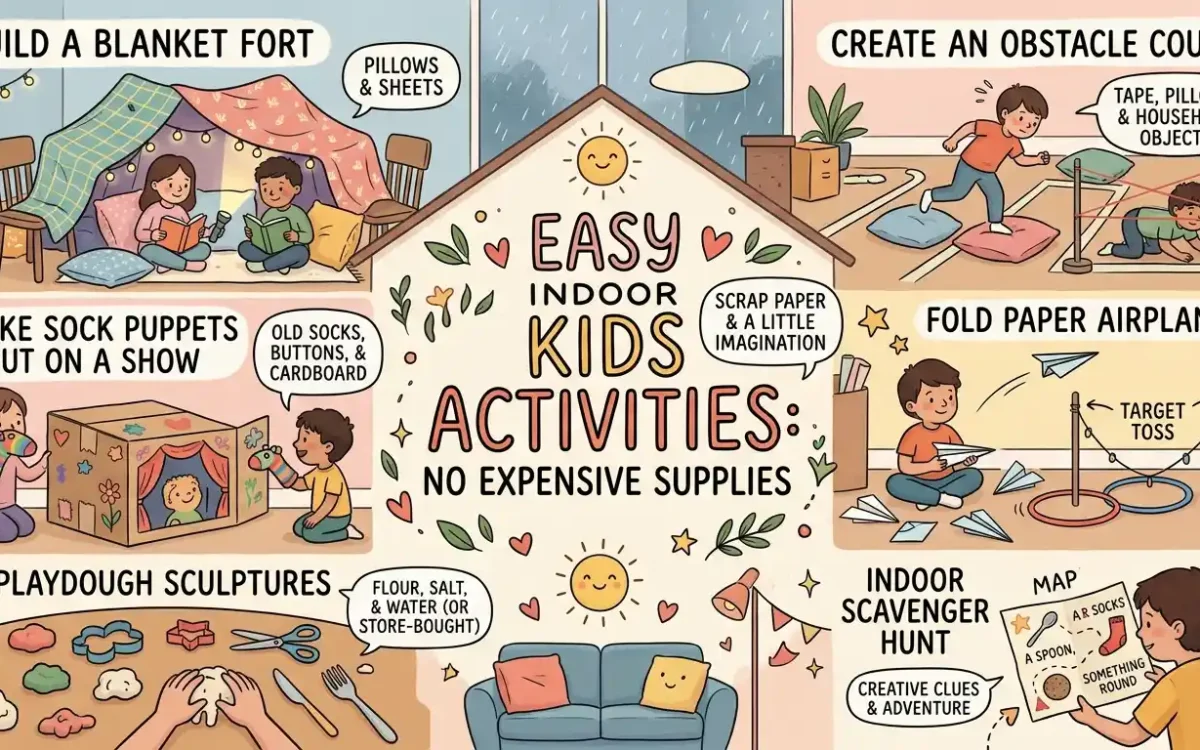
Use old cardboard boxes, blankets, and pillows to create a reading corner, castle, or secret clubhouse.
This activity develops creativity, imagination, and teamwork.
2. Paper Airplane Competition
Fold different paper airplane designs and test which one flies the farthest across the room.
Children learn experimentation, engineering concepts, and observation.
3. Storytelling Challenge
Let each family member tell one part of a story before passing it on to the next person.
Storytelling strengthens imagination, vocabulary, and communication.
4. Indoor Treasure Hunt
Hide handwritten clues around the house that lead children from one location to another before finding a small prize.
Treasure hunts improve observation and problem-solving skills.
5. Kitchen Science Experiments
Turn your kitchen into a science lab using simple household ingredients.
- Baking soda volcano
- Floating egg experiment
- Rainbow milk
- Dancing raisins
Hands-on experiments encourage scientific curiosity and critical thinking.
6. Build a Tower
Challenge children to build the tallest tower possible using paper cups, plastic cups, or cardboard tubes.
This activity develops planning, balance, and engineering thinking.
7. Draw a Family Comic Book
Create fun superheroes inspired by family members and write exciting comic adventures together.
Comic books combine storytelling with artistic creativity.
8. Balloon Volleyball
Replace a regular ball with a balloon and enjoy safe indoor volleyball.
Balloon games encourage movement, coordination, and teamwork.
9. DIY Puppet Show
Make puppets using socks, paper bags, wooden spoons, or recycled materials before performing a short play.
Puppet shows improve communication, creativity, and confidence.
10. Indoor Camping
Build a pretend campsite using blankets, pillows, flashlights, and sleeping bags inside your living room.
Indoor camping encourages imaginative play and family bonding.
11. Create Art with Recycled Materials
Turn old newspapers, magazines, cardboard, bottle caps, and plastic containers into creative works of art.
Recycled art encourages creativity while teaching children about sustainability and resourcefulness.
12. Learn Basic Origami
Fold colorful paper into birds, flowers, boats, animals, and other simple creations using easy origami techniques.
Origami improves concentration, patience, and fine motor skills.
13. Read Together
Choose an interesting book and spend time reading together before discussing favourite characters and important lessons.
Reading builds vocabulary, comprehension, and communication skills.
14. Family Quiz Time
Create fun quizzes about animals, science, geography, sports, or general knowledge for the whole family.
Quiz games improve memory, teamwork, and critical thinking.
15. Practice Public Speaking
Encourage children to give a short presentation about their favourite hobby, dream career, or favourite animal.
Speaking in front of family members helps build confidence and communication skills.
16. DIY Obstacle Course
Arrange chairs, cushions, tape, and pillows to create a fun obstacle course throughout the house.
Indoor obstacle courses improve balance, coordination, and physical fitness.
17. LEGO Building Challenge
Challenge children to build creative structures such as a bridge, school, dream home, or space station.
- A bridge
- A school
- A space station
- A dream home
LEGO challenges strengthen engineering thinking and problem-solving skills.
18. Indoor Bowling
Use empty plastic bottles as bowling pins and roll a soft ball to knock them down.
Indoor bowling improves hand-eye coordination while providing active family fun.
19. Learn Simple Magic Tricks
Practice beginner-friendly magic tricks before performing them for family members.
Magic builds confidence, creativity, presentation skills, and patience.
20. Make a Gratitude Jar
Write one positive thought, achievement, or happy memory each day and place it inside a decorated jar.
Gratitude activities encourage emotional well-being and positive thinking.
21. Start a Mini Garden
Plant herbs or flowers in recycled containers and encourage children to water and care for them every day.
Gardening teaches patience, responsibility, and an appreciation for nature.
22. Create a Family Newspaper
Design your own newspaper featuring family news, weather reports, interviews, jokes, comics, and fun stories.
This activity develops writing, creativity, and communication skills.
23. Design Your Dream Business
Encourage children to invent a product, create a company name, design a logo, and think about who would buy it.
Children learn entrepreneurship, creativity, and problem-solving.
24. Play Memory Games
Place several household objects on a tray, let children observe them, cover the tray, and ask them to remember as many items as possible.
Memory games improve concentration and observation skills.
25. Create Musical Instruments
Use rice, bottles, rubber bands, cans, and boxes to build homemade musical instruments.
Children explore sound while developing creativity and fine motor skills.
26. Learn Basic Coding
Introduce beginner-friendly coding platforms like Scratch that teach programming through games and animations.
Coding builds logical thinking, sequencing, and digital skills.
27. Solve Brain Teasers
Complete riddles, crosswords, Sudoku puzzles, and logic games together.
Brain teasers strengthen critical thinking and analytical skills.
28. Practice Yoga Together
Spend a few minutes doing simple yoga poses and breathing exercises as a family.
Yoga improves flexibility, concentration, relaxation, and emotional well-being.
29. Build a Marble Maze
Create exciting marble tracks using cardboard, drinking straws, tape, and recycled materials.
Marble mazes introduce engineering concepts while encouraging experimentation.
30. Become an Inventor
Challenge children to solve a household problem using only recycled materials and their imagination.
Inventing encourages innovation, creativity, and problem-solving skills.
Household Items You Already Have
Many engaging indoor activities require only common household materials that are already available in most homes.
- Paper
- Cardboard boxes
- Plastic bottles
- Newspapers
- Old magazines
- Glue
- Tape
- Crayons
- Markers
- Scissors (with adult supervision)
- String
- Socks
- Cups
- Empty containers
Creativity always matters more than expensive supplies. A little imagination can turn everyday household items into exciting learning opportunities.
Skills Children Build Through Indoor Activities
| Activity | Skills Developed |
|---|---|
| Storytelling | Communication |
| Science Experiments | Critical Thinking |
| Arts & Crafts | Creativity |
| Treasure Hunts | Problem Solving |
| Public Speaking | Confidence |
| Business Projects | Entrepreneurship |
| Gardening | Responsibility |
| Memory Games | Concentration |
Benefits of Screen-Free Indoor Activities
Replacing excessive screen time with meaningful indoor activities helps children stay active, curious, and engaged while developing important life skills. Even simple activities can make a lasting impact on a child's overall development.
Screen-free activities help children:
- Stay physically active indoors
- Improve attention span and concentration
- Strengthen family relationships
- Develop independent thinking
- Build emotional resilience
- Increase curiosity and creativity
- Improve communication and social skills
Just one hour of creative, hands-on play each day can positively influence a child's confidence, imagination, and love for learning.
How Kidspreneur Encourages Hands-On Learning
At Kidspreneur, we believe children learn best by doing. Our activity-based programs help young learners explore ideas, solve real-world problems, and develop future-ready skills in an engaging environment.
Entrepreneurship
Children learn how to generate business ideas, identify opportunities, solve problems, and understand the basics of entrepreneurship through practical projects.
STEM Learning
Interactive science, engineering, technology, and mathematics activities encourage curiosity, experimentation, and innovation.
Artificial Intelligence
Age-appropriate AI lessons introduce children to future technologies through engaging and easy-to-understand activities.
Leadership & Communication
Presentations, storytelling, teamwork, and group discussions help children become confident communicators and future leaders.
Sustainability
Eco-friendly projects and creative recycling activities teach children environmental responsibility while encouraging innovative thinking.
Every Kidspreneur program combines creativity, collaboration, and practical learning to prepare children for the future.
Tips for Parents
You don't need a large budget to create meaningful learning experiences at home. Small changes can make everyday activities both educational and enjoyable.
- Keep a small box of recycled craft materials ready.
- Rotate activities every week to maintain excitement.
- Encourage children to solve challenges independently.
- Join activities whenever possible and learn together.
- Praise creativity, effort, and problem-solving instead of perfection.
- Allow children enough time to explore without rushing them.
Often, the simplest activities become the most memorable childhood experiences.
Final Thoughts
Creating meaningful learning experiences at home doesn't require expensive toys or elaborate equipment. With a little imagination and everyday household items, children can explore science, strengthen communication skills, build creativity, and develop confidence while having fun.
Whether they're building a cardboard fort, inventing a new game, creating recycled artwork, or solving a family treasure hunt, every activity contributes to their personal growth and lifelong learning.
Remember, the goal isn't to fill every minute with structured lessons. It's to provide opportunities for children to explore, ask questions, experiment, make mistakes, and enjoy learning.
The best childhood memories often begin with the simplest ideas.
Frequently Asked Questions
Children can enjoy storytelling, paper crafts, treasure hunts, science experiments, indoor bowling, balloon volleyball, puppet shows, reading, origami, and recycled art projects using everyday household items like cardboard, paper, plastic bottles, and newspapers.
Use materials you already have, such as cardboard boxes, paper, newspapers, plastic bottles, kitchen utensils, and recycled containers. These simple items can be transformed into educational games, DIY crafts, STEM activities, and imaginative play without spending extra money.
Screen-free activities encourage creativity, communication, physical movement, problem-solving, and stronger family interactions. They also help children develop healthy habits while reducing excessive screen time.
Indoor activities help children build creativity, confidence, communication, teamwork, leadership, problem-solving, critical thinking, concentration, and independence. Many activities also improve emotional resilience and decision-making skills.
Kidspreneur offers engaging, activity-based programs in entrepreneurship, STEM, artificial intelligence, leadership, communication, and sustainability. Through practical projects and collaborative learning, children develop future-ready skills while enjoying hands-on educational experiences.
Search
Recent Posts
16 September, 2026
Top Kids Activities for Preschoolers: Fun & Educational Ideas
16 September, 2026
Fun Science Activities for Kids Using Household Items