



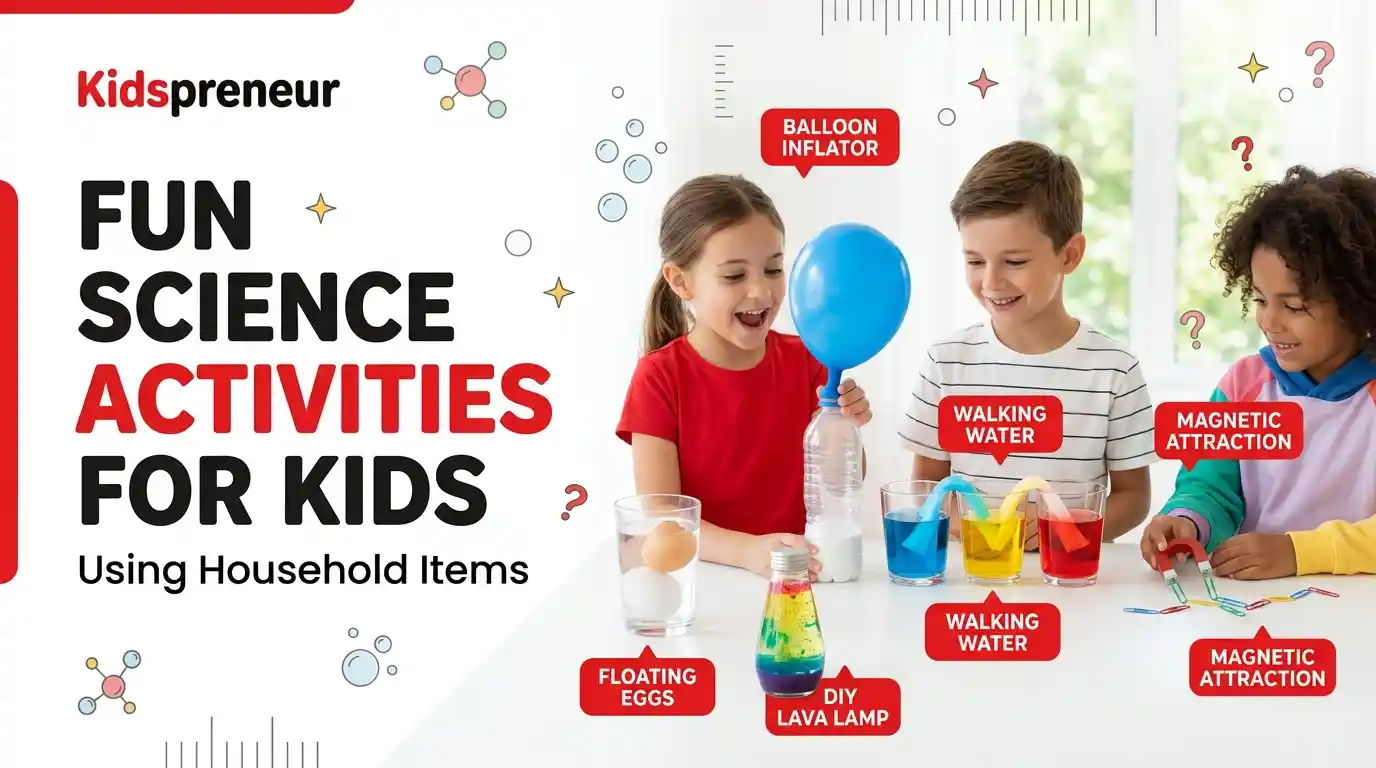
Fun Science Activities for Kids Using Household Items
You don't need a laboratory, fancy equipment, or a complicated setup to teach your kids science. Some of the best science lessons are already sitting in your kitchen cupboard, bathroom cabinet, or junk drawer.
With just a handful of everyday items, kids can explore gravity, air pressure, chemical reactions, density, magnetism, and a lot more — all while having a genuinely good time.
These fun science activities for kids using household items are easy enough to pull off on a random Tuesday afternoon, and interesting enough to get your child asking, "Wait, why did that happen?"
That question, right there, is where real learning starts.
Whether you're a parent hunting for a weekend activity, a teacher planning something hands-on, or a homeschooling family looking for simple experiments, these ideas turn ordinary household clutter into a mini science lab.
⚠️ A Quick Safety Note
Young children should always do these experiments with an adult nearby. Steer clear of anything involving heat, sharp objects, electricity, or chemicals that aren't meant for kids.
Why Bother With Science at Home?
Kids are natural explorers. They drop things, mix things, splash water everywhere, stack things up just to knock them down, and ask a hundred questions a day.
Instead of just answering those questions for them, science activities let kids make a guess, test it out, watch what happens, and then try to explain it themselves.
That's really the whole foundation of scientific thinking.
And the best part? You probably already own most of what you need.
Let's turn this ordinary stuff into something exciting.
The Magic Balloon Experiment
A balloon, an empty plastic bottle, baking soda, vinegar, and a funnel or a rolled piece of paper.
How to Do It
- Pour a bit of vinegar into the bottle.
- Spoon some baking soda into the balloon.
- Carefully stretch the balloon over the bottle's neck.
- Lift the balloon so the baking soda drops into the vinegar.
- Watch closely — the balloon starts to inflate.
What's Actually Happening?
Baking soda and vinegar react chemically and produce carbon dioxide gas. That gas has to go somewhere, so it rushes up into the balloon and puffs it out.
Ask Your Child
"What do you think would happen if we used more baking soda?"
The Floating Egg Experiment
Want an easy way to introduce the idea of density? Grab an egg and some salt water.
Two glasses, water, salt, two eggs, and a spoon.
Steps
- Fill both glasses with water.
- Leave one glass plain.
- Stir several spoonfuls of salt into the other until it dissolves.
- Gently lower an egg into each glass.
Why?
Salt makes the water denser. Once the water is dense enough, it can push back hard enough to hold the egg up.
Try Asking
"Why do you think it's easier for people to float in the ocean than in a swimming pool?"
Dancing Raisins
This one genuinely looks like magic the first time you see it.
A clear glass, sparkling water or a clear fizzy drink, and a handful of raisins.
Steps
- Fill the glass with fizzy water.
- Drop in a few raisins.
- Watch carefully.
What's Happening?
Tiny carbon dioxide bubbles cling to the raisins' bumpy surface and lift them toward the top. Once those bubbles pop at the surface, the raisin gets heavy again and sinks.
It's a fun, visual way for kids to see gas bubbles, buoyancy, and density working together in real time.
Rainbow Walking Water
Part science experiment, part art project.
Three clear glasses, water, food coloring, and paper towels.
Steps
- Fill the first and third glasses with water and different colors.
- Leave the middle glass empty.
- Fold paper towel strips.
- Place the strips between the glasses.
- Wait and watch.
Why Does This Happen?
Water can travel through the tiny gaps in certain materials. This process is called capillary action. Plants rely on a similar process to move water upward.
Try Asking
"How do you think a tree gets water all the way up to its leaves?"
A Mini Tornado in a Bottle
Kids can't get enough of watching water swirl.
A clear plastic bottle, water, a small squirt of dish soap, and glitter if you want a bit of sparkle.
Steps
- Fill the bottle about three-quarters with water.
- Add a little dish soap and optional glitter.
- Seal it tightly.
- Swirl the bottle in circular motions.
- Stop and watch.
What's Happening?
The spinning motion creates a vortex, and the water spins around a hollow center.
The Pepper and Soap Trick
One of the simplest experiments on this whole list.
A shallow plate, water, ground black pepper, and dish soap.
Steps
- Pour water onto the plate.
- Sprinkle pepper over the surface.
- Ask your child to guess what will happen.
- Dip your fingertip in dish soap.
- Touch the center of the water.
Why?
Soap changes the water's surface tension. That sudden change causes the surface to move, carrying the pepper with it.
Can You Float a Paperclip?
Another simple, satisfying demonstration of surface tension.
A bowl of water, a paperclip, a small piece of tissue, and a pencil or toothpick.
Steps
- Gently lay tissue on the water's surface.
- Carefully set a paperclip on top.
- Wait for the tissue to soak through and sink.
What's Happening?
A paperclip is denser than water, but the water's surface tension can help hold it up when placed gently.
Build a Balloon-Powered Car
Ready to try a little engineering?
Cardboard, four bottle caps, two skewers or sticks, two straws, a balloon, and tape.
Basic Steps
- Build a simple lightweight cardboard body.
- Tape straws underneath as supports.
- Slide sticks through the straws as axles.
- Attach bottle caps as wheels.
- Attach a balloon and straw to the car.
- Blow up the balloon.
- Let go and watch the car move.
The Science Behind It
As air rushes backward out of the balloon, it pushes the car forward. It's a hands-on look at action and reaction forces.
🏎️ Turn It Into a Challenge
- Can you make the car go farther?
- What happens if you make it lighter?
- Does wheel size matter?
- Which design is fastest?
Ice and Salt
A simple way to see how salt affects freezing.
Two ice cubes, salt, two plates, and water.
Steps
- Place one ice cube on each plate.
- Sprinkle salt over one.
- Leave the other alone.
- Watch both for several minutes.
Why?
Salt lowers water's freezing point, which is part of the reason it can be used to help melt ice in cold regions.
Homemade Lava Lamp
A colorful, bubbly favorite.
A clear glass or bottle, water, vegetable oil, food coloring, and an effervescent tablet.
Steps
- Fill most of the container with vegetable oil.
- Add water, leaving room at the top.
- Add a few drops of food coloring.
- Add a small piece of the tablet.
- Watch the colorful bubbles rise and fall.
Why Does This Happen?
Oil and water don't mix because of their different properties. The tablet creates gas bubbles that carry colored water upward. When the bubbles pop, the colored water sinks again.
Magnetic Treasure Hunt
Turn your living room into a mini research lab.
A magnet and a pile of safe household objects such as paper clips, plastic toys, coins, wooden pencils, metal spoons, bottle caps, and paper.
Ask your child to guess which items the magnet will pick up, then test each one and record the results.
| Object | Prediction | Result |
|---|---|---|
| Paper clip | Yes | Yes |
| Pencil | No | No |
| Plastic toy | No | No |
| Metal spoon | Maybe | Test it |
| Coin | Maybe | Test it |
Simple as it is, this activity teaches kids how scientists make predictions and record their observations.
Homemade Rain Cloud
A neat, hands-on way to bring the water cycle into your kitchen.
A clear glass, water, shaving foam, food coloring, and a spoon.
Steps
- Fill the glass with water.
- Spread a layer of shaving foam on top.
- Drop small amounts of food coloring onto the foam.
- Wait and watch.
What Does It Represent?
The shaving foam acts as a stand-in for a cloud. As the colored liquid moves through it, kids get a visual way to think about clouds filling with moisture and releasing it as rain.
How to Turn These Activities Into Real Learning
Doing an experiment is fun on its own. Asking the right questions is what turns it into learning.
Before each activity, try walking through this simple loop: Predict → Test → Observe → Explain.
Predict
What do you think will happen?
Test
Actually do the experiment together.
Observe
What did you notice?
Explain
Talk through why it happened.
Good Questions to Ask Along the Way
While you're working through any of these activities, try tossing in questions like:
🔍 Observe
- What do you think will happen?
- Why do you think that happened?
- Was your guess right?
- What changed?
- What stayed the same?
💡 Explore
- What could we change next time?
- What if we used more?
- What if we used less?
- Could we do this differently?
- How would we test that idea?
There's rarely a single "correct" answer here. Some of the best learning happens when a prediction turns out to be wrong and you get to figure out why together.
Making Science Part of Everyday Life
You don't need to block out two hours for a formal science lesson. Science shows up naturally throughout an ordinary day.
Kitchen
Explore melting, boiling and mixtures.
Garden
Observe leaves, bugs, soil and sunlight.
Bath Time
Explore floating, sinking and bubbles.
Cleanup
Test which materials absorb water.
Walk
Notice shadows, clouds and movement.
Science Activities by Age
The same experiment can look pretty different depending on your child's age.
| Age | Approach | Example |
|---|---|---|
| 3–5 | Observe and describe | Floating and sinking |
| 5–7 | Predict and test | Pepper and soap |
| 7–9 | Compare results | Salt and ice |
| 9–12 | Measure and record | Balloon-powered car |
| 12+ | Design their own experiments | Changing variables |
The Real Goal
The goal was never to make every activity harder — it's to keep kids curious enough to keep asking questions.
How Kidspreneur Fits Into This
At Kidspreneur, we believe learning goes well beyond worksheets and textbooks. Hands-on activities like these give kids real practice with skills that matter far beyond science class.
A child who gets comfortable asking "Why?", "What if?", and "Can I try it a different way?" is building a mindset that will serve them well long after the experiment is over.
Frequently Asked Questions
What are fun science activities for kids using household items?
They're simple experiments built around things you already have at home — balloon experiments, floating eggs, walking water, homemade lava lamps, magnet hunts, balloon-powered cars, and more.
What science experiments can kids do at home?
Plenty — using water, air, magnets, ice, balloons, baking soda, vinegar, paper, and other everyday materials. Choose activities suited to your child's age and supervise appropriately.
What's an easy first science experiment for young kids?
Floating and sinking is a great starting point. Give your child a few safe objects, ask them to guess which will float and which will sink, and then test the prediction.
Can you do real science without expensive equipment?
Absolutely. Plenty of science concepts can be explored with water, paper, salt, balloons, cups, ice, magnets, and food coloring.
How can parents make science feel more interesting?
Let kids predict, test, observe, and explain in their own words. Turning an experiment into a small challenge or open question can make learning much more interactive.
Are household science experiments safe for kids?
Generally, yes, with adult supervision and age-appropriate materials. Avoid dangerous chemicals, fire, electricity, sharp objects, or small parts that could be swallowed.
Pick One. Make a Prediction. Start Exploring!
Science doesn't need to start in a lab. It can start with a glass of water, a balloon, a magnet, or an egg sitting on your counter.
The best fun science activities for kids using household items get children to pause, look closely, ask questions, make a guess, and find out if they were right.
Next time your child asks, "Can we do a science experiment?" check around the house first. Chances are, you already have everything you need.
Pick one, make a prediction, and start exploring.
Search
Recent Posts
16 September, 2026
Top Kids Activities for Preschoolers: Fun & Educational Ideas
16 September, 2026
Fun Science Activities for Kids Using Household Items