



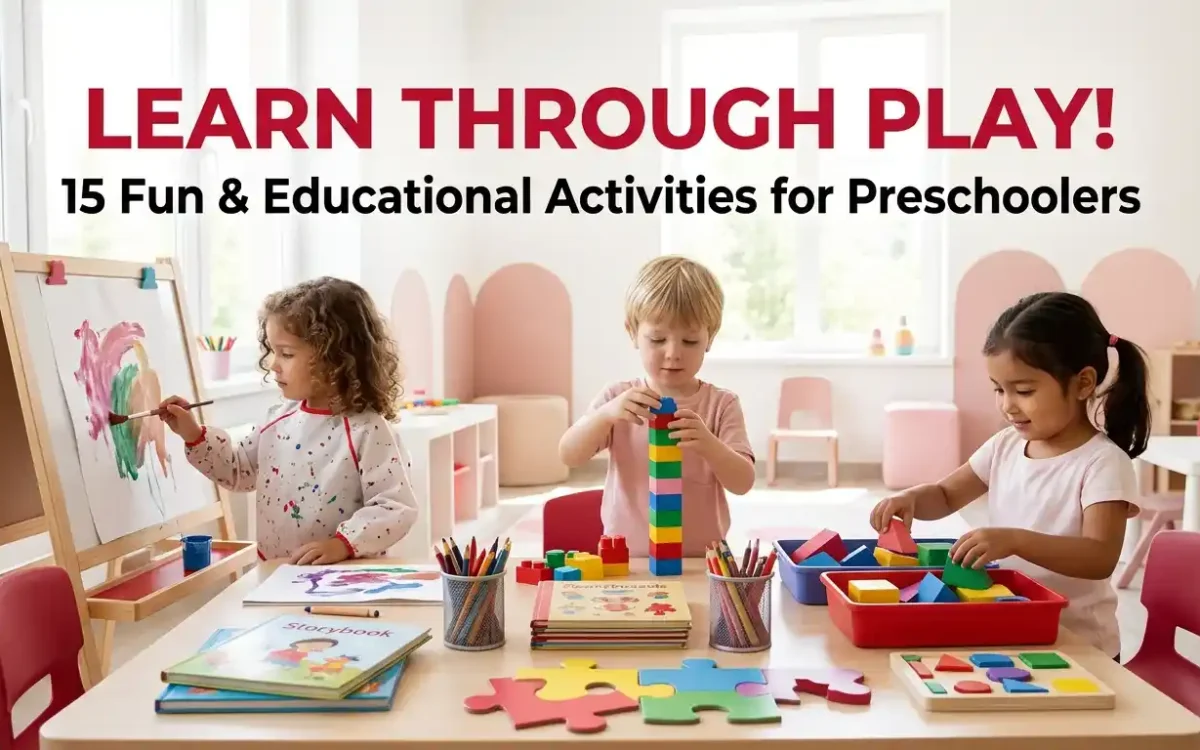
15 Fun and Educational Kids Activities for Preschoolers
The preschool years are an exciting stage of childhood. Young children are naturally curious, energetic, and eager to explore the world around them. The right activities can turn everyday playtime into meaningful learning experiences that develop creativity, communication, coordination, and confidence.
If you are looking for engaging kids activities for preschoolers, you do not need expensive toys or complicated learning materials. Simple activities such as sorting colours, building blocks, storytelling, painting, and sensory play can help children develop important early learning skills while having fun.
In this guide, you will discover 15 enjoyable activities for preschool children that parents and caregivers can try at home. These ideas combine creativity, movement, problem-solving, and early education to make learning a natural part of everyday life.
Why Are Activities Important for Preschoolers?
Preschool children learn best when they can actively explore, experiment, move, create, and interact with their surroundings. Play is more than entertainment at this age. It gives children opportunities to practise new skills and understand how the world works.
Well-planned kids activities for preschoolers support different areas of early childhood development. A simple puzzle can encourage problem-solving, while drawing and painting help children express ideas and strengthen hand coordination.
Regular play-based learning can support:
- Fine motor skills: Using fingers and hands for drawing, cutting with child-safe scissors, sorting, and building.
- Gross motor skills: Running, jumping, balancing, dancing, and other full-body movements.
- Language development: Learning new words, describing objects, listening, and telling stories.
- Social skills: Sharing, taking turns, cooperating, and communicating with others.
- Creative thinking: Exploring colours, shapes, music, art, and imaginative play.
- Problem-solving: Finding solutions through puzzles, building activities, and simple challenges.
15 Best Kids Activities for Preschoolers
The following preschool learning activities are simple, enjoyable, and easy to adapt according to a child's interests. Most can be prepared with common household or classroom materials.
Colour Sorting Game
Help children recognise colours through a simple sorting challenge. It is an excellent activity for developing observation and early classification skills.
How to play: Place different coloured objects on a table. Ask your child to group each object according to its colour. Start with two or three colours and introduce more as they become comfortable.
Skills developed: Colour recognition, visual discrimination, sorting, and early thinking skills.
DIY Paper Plate Art
Encourage creativity by turning simple paper plates into colourful artwork, animals, or imaginary characters.
How to play: Give your child a paper plate and let them decorate it. They can create a sun, flower, animal face, or anything they imagine.
Skills developed: Creativity, colour awareness, hand coordination, and self-expression.
Building Blocks Challenge
Building towers and simple structures helps preschoolers explore shapes, balance, size, and spatial relationships.
How to play: Invite your child to build a tall tower, a house, a bridge, or a small town. Ask what happens when they add more blocks or change the base.
Skills developed: Early engineering thinking, coordination, creativity, and problem-solving.
Shape Hunt Around the House
Turn your home into a learning adventure by finding everyday objects that represent different shapes.
How to play: Show your child a shape and ask them to find objects that look similar. For example, a clock may look like a circle, while a book may look like a rectangle.
Skills developed: Shape recognition, observation, vocabulary, and early mathematics.
Storytelling with Picture Cards
Picture-based storytelling helps young children develop language skills and use their imagination.
How to play: Show your child three or four pictures and ask them to create a short story. Encourage them to describe what is happening and what might happen next.
Skills developed: Vocabulary, communication, imagination, and sequencing.
Sensory Rice Play
Sensory play gives children opportunities to explore different textures while practising careful hand movements.
How to play: Place a small amount of dry rice in a tray. Let children scoop, pour, and transfer it between containers while describing how it feels and moves.
Skills developed: Sensory exploration, coordination, concentration, and descriptive language.
Safety: Use only with close adult supervision. Rice is a choking hazard for young children and should not be used by children who may put it in their mouths.
Nature Collection Walk
Take learning outdoors and encourage children to observe the natural world around them.
How to play: Walk around a garden or safe outdoor area. Ask your child to notice different colours, shapes, plants, and sounds. Collect only safe items that are permitted to be picked up.
Skills developed: Observation, curiosity, vocabulary, and environmental awareness.
Number Counting Game
Introduce early mathematics through a playful counting activity using large objects.
How to play: Place a few objects in front of your child. Count them together, then ask your child to make groups of two, three, or four.
Skills developed: Number recognition, counting, comparison, and early mathematical understanding.
Playdough Shape Making
Playdough activities are a fun way to practise hand movements and explore shapes.
How to play: Ask your child to roll, flatten, and shape the playdough. Make simple circles, squares, letters, or pretend food items.
Skills developed: Fine motor development, creativity, shape recognition, and hand strength.
Safety: Supervise play and make sure the playdough is suitable for the child's age. Do not allow children to eat it.
Music and Movement Time
Music encourages children to move, listen, express emotions, and develop coordination.
How to play: Play an enjoyable song and encourage your child to clap, march, stretch, dance, or move like different animals.
Skills developed: Gross motor skills, rhythm, listening, confidence, and body awareness.
Simple Matching Puzzle
Matching games help children recognise patterns and understand how different pieces connect.
How to play: Place a few picture cards on the table and ask your child to match identical pictures or related objects. Gradually introduce more choices.
Skills developed: Memory, visual recognition, concentration, and problem-solving.
Water Pouring Station
A supervised water activity helps children explore pouring, filling, and comparing quantities.
How to play: Fill a shallow tray with a small amount of water. Let your child pour water from one container to another and compare which holds more or less.
Skills developed: Hand-eye coordination, early measurement, observation, and concentration.
Safety: Keep water shallow and supervise continuously. Never leave a young child alone near water, even for a moment.
Animal Movement Game
Turn physical movement into an imaginative activity by pretending to move like different animals.
How to play: Call out an animal and ask your child to imitate its movement. They can hop like a rabbit, stretch like a cat, or flap their arms like a bird.
Skills developed: Gross motor skills, imagination, listening, and body coordination.
Simple Gardening Activity
Introduce children to plants and nature by letting them help with a small gardening task.
How to play: With adult help, place a seed in the soil, cover it gently, and water it. Encourage your child to observe changes over the following days.
Skills developed: Responsibility, observation, patience, and an understanding of nature.
Safety: Choose safe seeds and plants, supervise handling of soil, and wash hands after gardening.
Make Your Own Mini Storybook
Help children turn their imagination into a small book filled with pictures and simple stories.
How to play: Fold a few sheets of paper into a small book. Ask your child to draw a character, a place, and something that happens. Let them explain the story while an adult writes down their words.
Skills developed: Creativity, early literacy, storytelling, communication, and confidence.
Indoor Activities for Preschoolers on Rainy or Busy Days
Children do not always need outdoor spaces to stay active and engaged. Indoor activities for preschoolers can provide opportunities to move, create, explore, and learn when going outside is not practical.
- Indoor obstacle course: Use cushions and soft objects to create a simple course for stepping around or walking over, with adult supervision.
- Colour hunt: Ask your child to find safe objects around the room that match a chosen colour.
- Dance and freeze: Play music and ask children to freeze when the music stops.
- Story corner: Read a picture book and ask questions about the characters and illustrations.
- Paper collage: Create pictures using large pre-cut paper shapes and child-safe glue.
- Sorting challenge: Group large toys according to colour, size, or type.
How to Choose the Right Activities for Your Preschooler
Every child develops at a different pace. An activity that is easy for one child may require more support for another. When selecting kids activities for preschoolers, focus on their interests, abilities, and comfort rather than comparing them with other children.
Consider Their Age and Abilities
Choose simple activities that your child can explore with the right amount of adult support. Make tasks easier or more challenging when needed.
Follow Their Interests
If your child enjoys animals, include animal stories, movement games, or nature activities. Personal interests can make learning more engaging.
Balance Different Skills
Include a mixture of art, movement, language, sensory exploration, early maths, and imaginative play instead of repeating only one type of activity.
Keep Activities Flexible
Preschoolers have different attention spans. Keep activities short, offer breaks, and allow children to stop or repeat an activity when appropriate.
How Learning Through Play Supports Early Childhood Development
Learning through play gives preschool children opportunities to practise important skills in a natural and enjoyable way. It combines exploration with interaction, allowing children to learn through experiences rather than simply memorising information.
For example, a building-block activity can introduce early engineering concepts. A storytelling game can support vocabulary and communication. Painting can encourage creative expression, while a simple sorting game can introduce early mathematical thinking.
These experiences help children develop confidence as they discover what they can do. They also learn to try again when something does not work the first time, an important part of developing persistence and problem-solving abilities.
How Parents Can Make Playtime More Meaningful
Parents play an important role in creating positive learning experiences. You do not need to organise complicated lessons every day. A little encouragement, conversation, and shared play can make ordinary activities more valuable.
- Ask open-ended questions such as "What do you think will happen next?"
- Give children time to explore materials and make their own choices.
- Encourage them to describe colours, shapes, sounds, and feelings.
- Celebrate effort and curiosity rather than expecting perfect results.
- Join in when your child invites you to play.
- Provide opportunities for both independent play and group activities.
- Use everyday routines, such as tidying toys or preparing snacks, as opportunities to practise counting and sorting.
The most meaningful learning experiences often happen when children feel supported, listened to, and free to explore.
Make Every Learning Moment Count with Kidspreneur Club
Early childhood is a wonderful time to build curiosity, creativity, confidence, and a love of learning. Simple preschool activities can introduce children to new ideas and help them develop skills they will continue using as they grow.
At Kidspreneur Club, children can explore engaging learning experiences designed to encourage creativity, innovation, practical thinking, and future-ready skills.
Whether children enjoy art, science, storytelling, or creative challenges, giving them opportunities to explore different interests can help make learning more exciting and meaningful.
Little Activities. Big Learning Moments!
Encourage your preschooler to explore, imagine, create, and discover something new every day. Start with one simple activity and make playtime a meaningful learning experience.
Explore Kidspreneur ClubFrequently Asked Questions
1. What are the best kids activities for preschoolers?
Some of the best activities include colour sorting, building blocks, storytelling, painting, puzzles, sensory play, nature walks, counting games, and music activities. These experiences help preschool children develop creativity, communication, coordination, and early learning skills.
2. What are some educational activities for preschoolers at home?
Parents can try shape hunts, number counting, picture-card storytelling, playdough activities, simple puzzles, and gardening. These educational activities use everyday materials to introduce early maths, language, science, and creative thinking.
3. How can I keep my preschooler busy indoors?
You can organise indoor activities such as drawing, building blocks, colour hunts, dancing, matching games, storytelling, and paper crafts. Offer a variety of short activities and allow your child to take breaks when needed.
4. How do activities help preschool children's development?
Play-based activities support fine and gross motor skills, language development, creativity, social interaction, problem-solving, and early mathematical understanding. They give children opportunities to learn by exploring and practising new skills.
5. What activities improve fine motor skills in preschoolers?
Activities such as drawing, painting, playdough shaping, large-piece puzzles, sorting objects, and placing large blocks together can help children practise hand and finger movements. Always choose materials that are safe and appropriate for the child's age.
6. How long should preschool children spend on activities?
There is no single time limit that suits every child. Choose activities according to your child's interest and attention span. Some children may enjoy an activity for a few minutes, while others may continue for longer. Allow breaks and avoid forcing participation.
7. Why is learning through play important for preschoolers?
Learning through play allows children to explore ideas, practise skills, express themselves, and interact with others. It makes early learning enjoyable and helps connect new concepts with real-life experiences.
Final Thoughts
The best kids activities for preschoolers are not necessarily the most expensive or complicated ones. Simple experiences such as drawing, building, sorting, storytelling, dancing, and exploring nature can provide valuable opportunities for early learning.
Give your child time to play, ask questions, make discoveries, and express their imagination. With encouragement and age-appropriate activities, everyday playtime can become a wonderful foundation for lifelong learning.
Search
Recent Posts
14 November, 2026
Why Should Children Learn Artificial Intelligence at an Early Age?
14 November, 2026
10 Fun STEM Activities for Kids to Try This Winter