



10 Fun Kids Activities for Rainy Days
Rainy weather doesn't have to mean a boring day indoors. Discover 10 fun kids activities for rainy days that encourage creativity, movement, learning, imagination, and family connection without requiring expensive supplies.
Rain can quickly change a child's plans. Outdoor games may be cancelled, trips to the park may not be possible, and children can suddenly find themselves asking the familiar question: "What can I do?"
Fortunately, rainy days can also create wonderful opportunities for indoor play and learning. Your home can become a mini art studio, science laboratory, theatre, library, or even an imaginary business.
The best part is that many kids activities for rainy days require only simple materials you probably already have at home.
Why Rainy Day Activities Are Important for Children
Children need opportunities to play, move, communicate, and explore even when they cannot go outside.
Well-planned indoor activities can help children use their time positively while developing important skills.
Rainy day activities can encourage:
- Creativity
- Imagination
- Problem-solving
- Communication
- Fine motor skills
- Physical movement
- Teamwork
- Confidence
- Curiosity
- Independent thinking
10 Fun Indoor Activities for Rainy Days
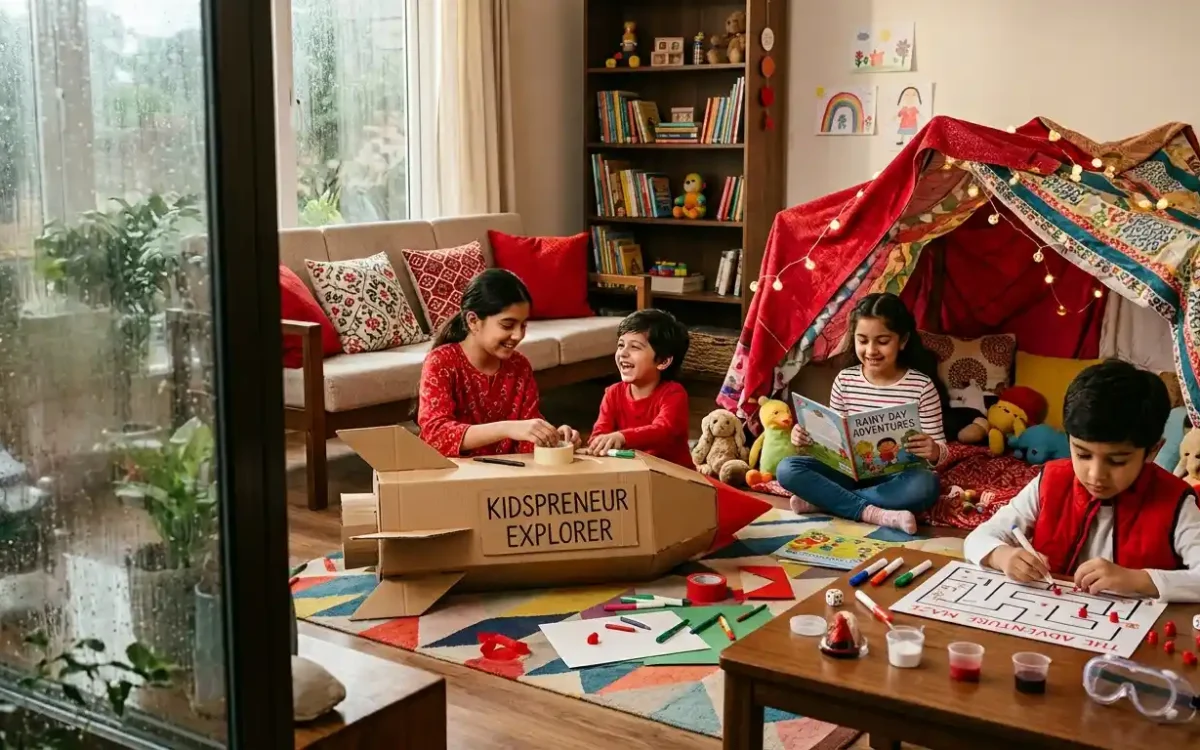
Build an Indoor Blanket Fort
A blanket fort can turn an ordinary living room into a secret clubhouse, reading corner, castle, or adventure base.
Use blankets, cushions, chairs, and pillows to create a safe indoor space.
Once the fort is ready, children can use it for reading, storytelling, pretend play, or simply relaxing.
Have a Rainy Day Treasure Hunt
Turn your home into an adventure by organizing a simple treasure hunt.
Hide several safe objects and create clues that lead children from one location to another.
Younger children can search for objects based on colors and shapes, while older children can solve simple riddles.
Create a Cardboard Invention
Gather clean cardboard boxes, paper tubes, paper, tape, and washable markers.
Ask children to invent something that solves a problem.
For example, they could design:
- A robot helper
- A room-cleaning machine
- A flying car
- A pet-feeding machine
- A homework organizer
Encourage children to explain what their invention does and who would use it.
Start a Family Storytelling Game
Choose a character and begin a story with one sentence. Each family member then adds another sentence.
For example: "One rainy morning, a tiny door appeared under the stairs..."
Let children decide what happens next. The story can become funny, mysterious, adventurous, or completely imaginative.
Try a Simple Indoor Science Experiment
Rainy days are perfect for introducing children to simple science.
Try an age-appropriate experiment using safe household materials. For example, children can investigate which everyday objects float or sink in water.
Ask children to make a prediction before testing each object. Afterwards, discuss whether their prediction was correct.
Organize an Indoor Obstacle Course
Children still need physical movement when they're stuck indoors. Create a simple obstacle course using cushions, pillows, tape lines, and safe household objects.
Children might crawl under a table, walk along a taped line, step over cushions, or move around obstacles.
Keep the course in a safe area and remove anything that could cause trips or falls.
Have a DIY Art Challenge
Put paper, crayons, pencils, or washable markers on the table and give children a creative challenge.
Try prompts such as:
- Draw your dream playground.
- Create a new animal.
- Design a superhero.
- Draw a city in the future.
- Create a picture of your perfect rainy day.
Ask children to explain their artwork when they finish.
Turn Your Living Room Into a Pretend Shop
Use toys, books, empty clean packages, paper signs, and homemade play money to create a pretend store.
Children can take turns being customers and shopkeepers.
Encourage them to name their shop, organize products, create prices, greet customers, and explain what they are selling.
This is also an easy way to introduce basic entrepreneurship concepts through play.
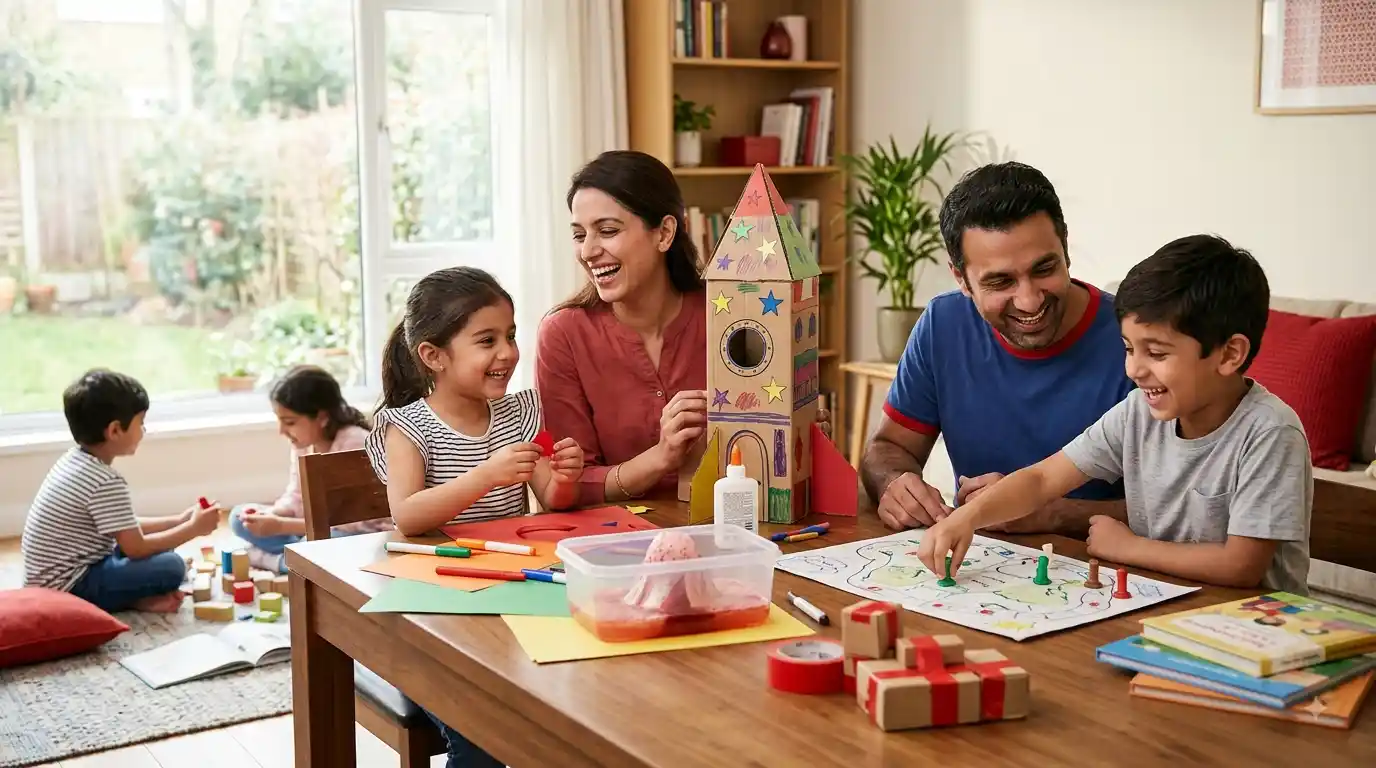
Create a Homemade Board Game
Take a piece of cardboard or paper and design a simple board game together as a family.
Children can decide the game's theme, draw the board, create rules, and make playing pieces from safe household items.
Add challenges such as answering a question, moving forward, taking another turn, or completing a funny action.
Have a Family Reading and Movie-Free Hour
Choose one hour during the rainy day when the family puts screens away.
Everyone can choose a book, magazine, comic, or story. Younger children can look at picture books while older children can read independently.
After reading, ask children about their favorite character, interesting idea, or funniest moment.
How to Keep Children Active Indoors
One challenge of rainy days is that children may spend too much time sitting or using screens.
Try alternating quiet activities with movement-based activities.
For example:
- Start with a drawing challenge.
- Move to an indoor obstacle course.
- Have a storytelling session.
- Take a break with a building activity.
- Finish with reading or a board game.
This variety can help children stay interested throughout the day.
Rainy Day Activities Don't Need Expensive Supplies
You don't need to purchase a new toy every time the weather changes.
Look around your home for materials that can be reused creatively.
- Cardboard boxes
- Paper
- Crayons
- Books
- Cushions
- Blankets
- Clean recyclable containers
- Toys
- Paper bags
Give children a challenge rather than a finished product. This allows them to become part of the creative process.
Parent Tip
Keep a small "rainy day activity box" with paper, crayons, cardboard, craft materials, puzzles, and activity cards.
When rain interrupts outdoor plans, you'll already have materials ready to go.
How Rainy Day Activities Support Learning
Indoor play can be educational without feeling like a formal lesson.
Building a cardboard invention introduces design and problem-solving. A storytelling game develops language skills. A pretend shop introduces counting and entrepreneurship. A science experiment encourages observation and prediction.
This is why activity-based learning can be so valuable. Children can develop useful skills while doing something they genuinely enjoy.
Rainy Days Are Great for Creativity
When outdoor options are limited, children often have more time to explore imaginative play.
A living room can become a spaceship. A cardboard box can become a robot. A blanket can become a castle. A few pieces of paper can become an entire story.
Give children permission to imagine beyond the obvious. You may discover that boredom is sometimes the starting point for creativity.
Using Rainy Days to Teach Life Skills
Rainy days can also be opportunities to teach practical skills.
Children can help organize activity materials, clean up after crafts, plan a family game, create rules, or explain an activity to a sibling.
These small responsibilities help children practice independence, organization, communication, and teamwork.
Introducing Entrepreneurship Through Indoor Play
Children don't need to run a real business to start learning about entrepreneurship.
A pretend shop can introduce concepts such as products, customers, prices, value, communication, and decision-making.
You can also ask children to invent a product during a rainy-day activity.
Ask them:
- What problem does your product solve?
- Who would use it?
- What would you call it?
- How would you explain it to someone?
- What makes your idea special?
These questions encourage children to think like young innovators.
How Kidspreneur Encourages Creative Learning
At Kidspreneur, children are encouraged to explore ideas through practical, creative, and engaging learning experiences.
Children can explore areas such as:
- Entrepreneurship
- STEM
- Artificial intelligence
- Innovation
- Creativity
- Communication
- Leadership
- Sustainability
These experiences can help children become more confident in exploring ideas, solving problems, communicating, and creating.
A Simple Rainy Day Activity Schedule
If you're looking for a simple way to structure a rainy day, try this flexible schedule:
- Morning: Art or building activity
- Late morning: Movement game
- Afternoon: Science or invention challenge
- Late afternoon: Storytelling or board game
- Evening: Family reading time
You don't have to follow the schedule exactly. Let your children's interests guide the day.
Safety Tips for Indoor Rainy Day Activities
Indoor activities should always be age-appropriate and supervised when necessary.
- Keep floors clear of unnecessary obstacles.
- Supervise movement games and obstacle courses.
- Use child-safe scissors and art supplies.
- Avoid small objects around young children who may swallow them.
- Supervise science activities involving water or other materials.
- Keep electrical devices and outlets away from water.
- Choose activities suitable for each child's age.
Final Thoughts
Rainy weather may cancel a trip to the park, but it doesn't have to cancel the fun.
With a little creativity, your home can become a classroom, art studio, science lab, theatre, playground, or business workshop.
The most important thing isn't how much an activity costs. It's whether children have the opportunity to participate, explore, create, communicate, and enjoy time with their families.
Turn Rainy Days Into Learning Adventures
The next time dark clouds arrive and outdoor plans disappear, don't worry about keeping children entertained with expensive activities.
Grab some paper, cardboard, blankets, books, or toys and give children a creative challenge.
A rainy day can become an opportunity for imagination, discovery, family bonding, and learning.
Frequently Asked Questions
1. What are the best kids activities for rainy days?
Some great rainy-day activities include blanket forts, indoor treasure hunts, cardboard inventions, storytelling, simple science experiments, art challenges, obstacle courses, pretend shops, homemade board games, and family reading time.
2. How can I keep kids busy indoors on a rainy day?
Give children a mixture of creative, educational, and physical activities. Building, drawing, storytelling, indoor games, science experiments, reading, and safe movement activities can help keep children engaged without relying entirely on screens.
3. What are some rainy-day activities that don't require expensive supplies?
Families can use cardboard boxes, paper, crayons, books, blankets, cushions, toys, and clean recycled materials for many indoor activities. Treasure hunts, storytelling, homemade games, drawing, and pretend play can also be done with little or no cost.
4. Are rainy-day activities educational for children?
Yes. Indoor activities can develop creativity, communication, problem-solving, observation, coordination, early scientific thinking, teamwork, confidence, and other important skills while children play.
5. How can Kidspreneur help children learn through activities?
Kidspreneur encourages activity-based learning in areas such as entrepreneurship, STEM, artificial intelligence, innovation, communication, creativity, leadership, and sustainability, helping children develop practical and future-ready skills.
Search
Recent Posts
13 August, 2026
12 Creative Kids Activities Using Household Items
13 August, 2026
10 Fun Kids Activities for Rainy Days